|
 |
 |
 |
 |
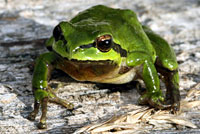
| Adult, Humboldt County |
 |
 |
 |
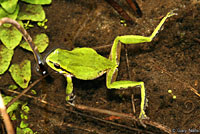 |
| Adult male, Humboldt County |
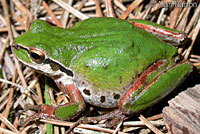
Adult, Humboldt County |
 |
 |
 |
 |
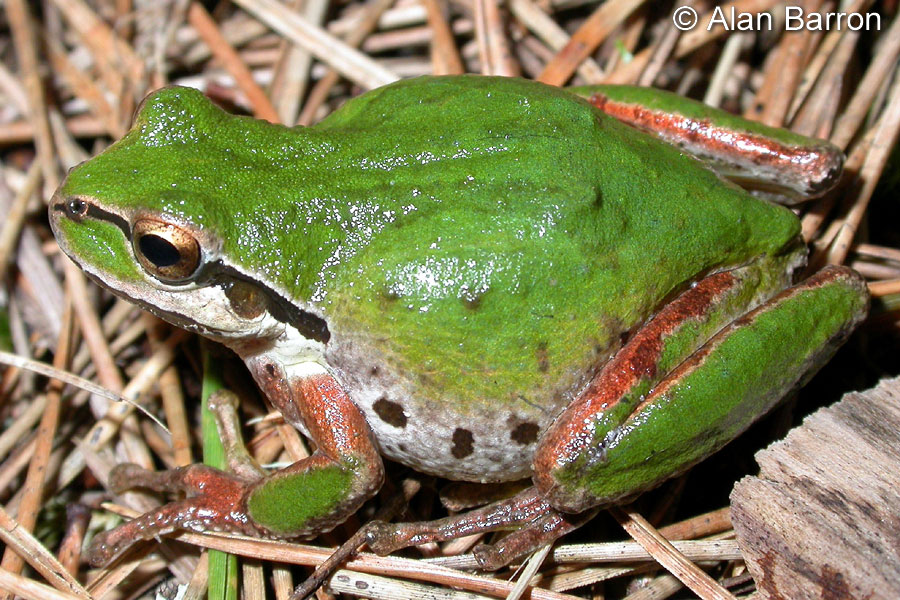
Adult, Del Norte County © Allan Barron
|
Adult, Del Norte County © Allan Barron |
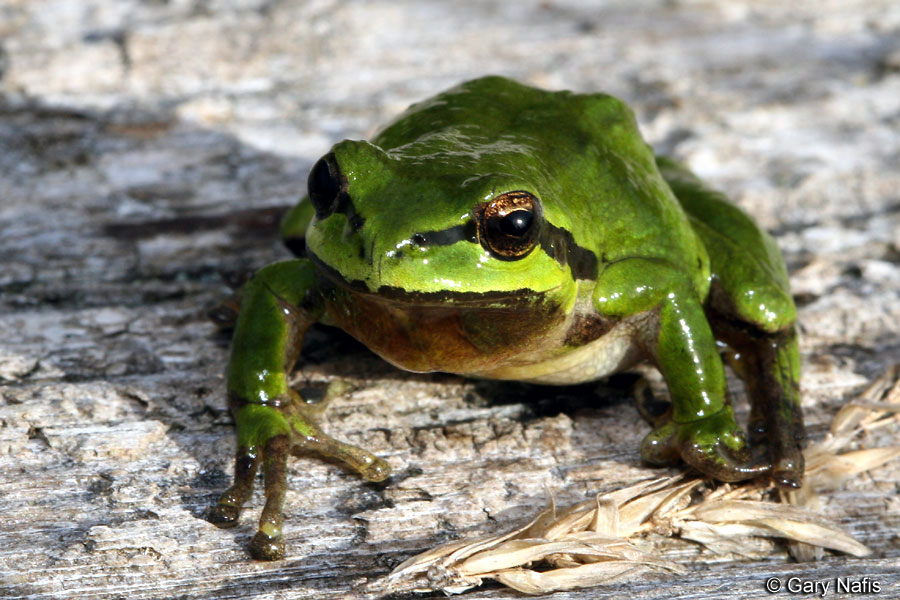
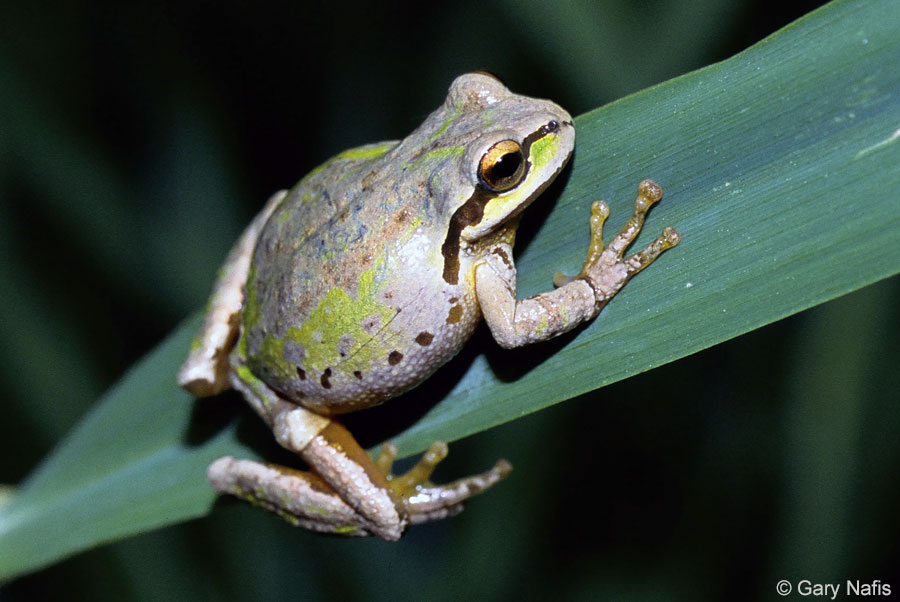
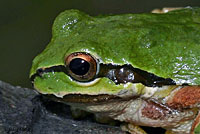
The dark stripe through the eye can help to identify this species. |
Adult, Humboldt County
© Nathan McCanne |
 |
 |
 |
 |
Leucistic adult, Humboldt County
© Nathan McCanne |
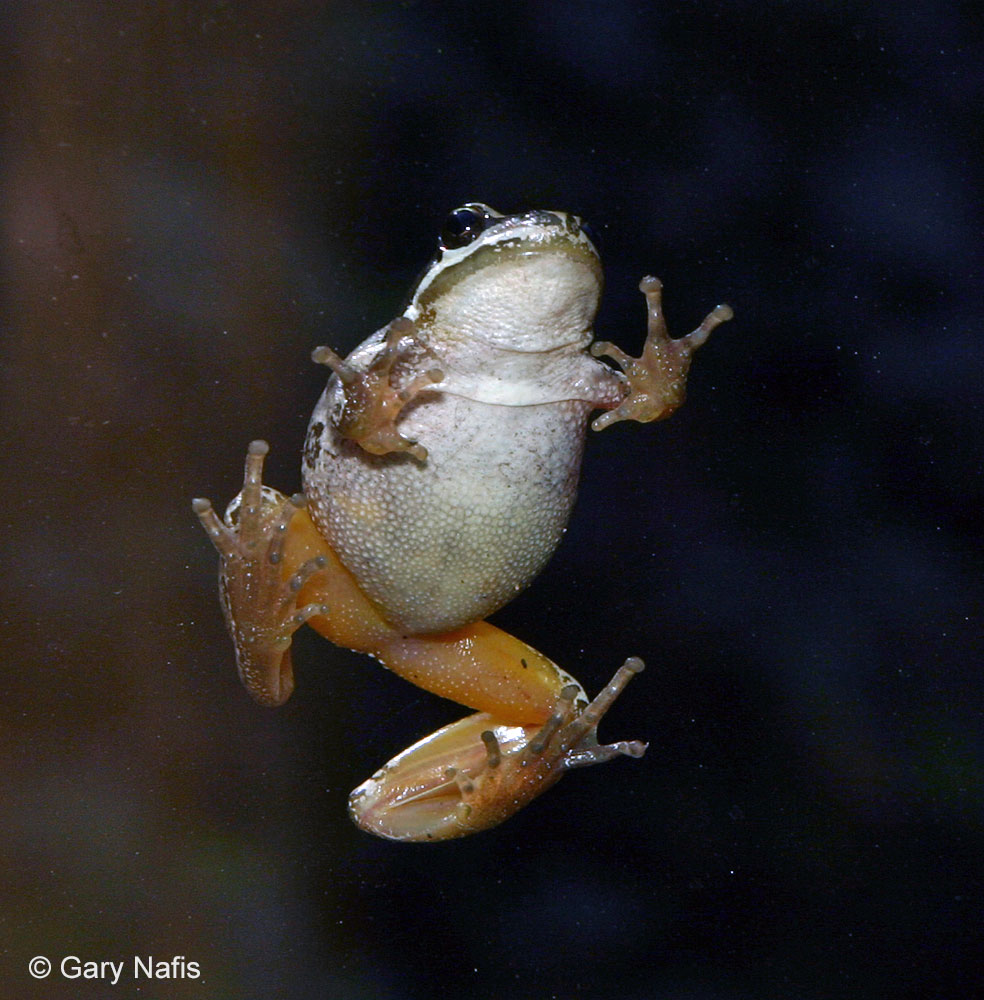
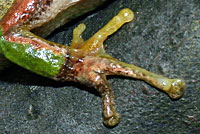
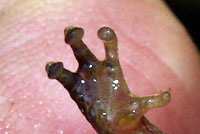
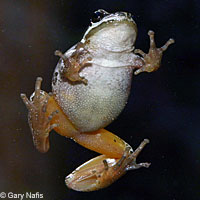
These treefrogs have enlarged rounded toe pads that help them climb and can help you distinguish treefrogs from other types of frogs and toads. |
The toe pads are like little suction cups (seen here from underneath the toes.)
|
Using the enlarged pads on their toes, Treefrogs are excellent climbers. This one is hanging onto a glass car window.
|
 |
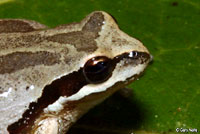 |
|
|
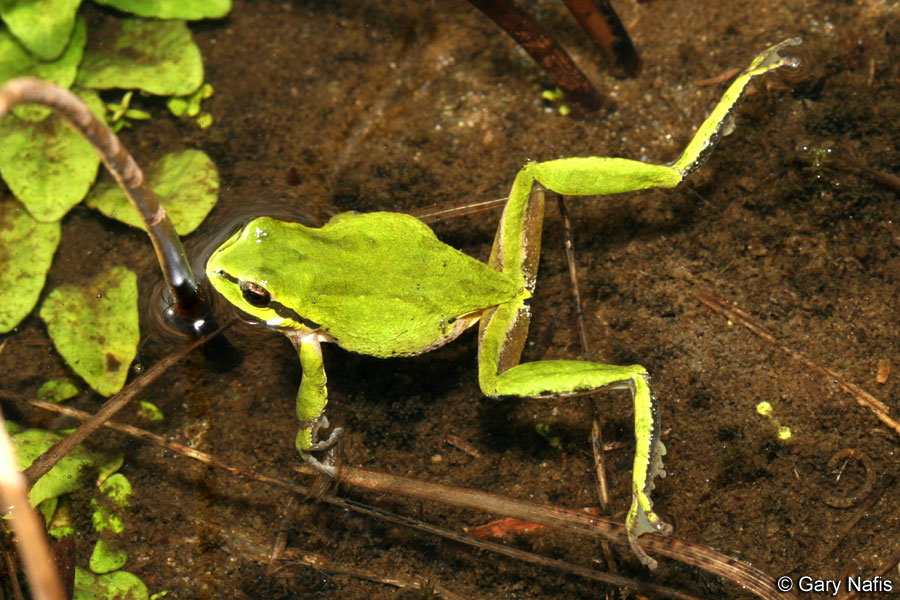
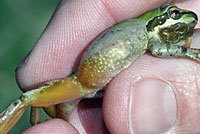
| Adult Sierran treefrog, showing the yellow "flash color" markings on the inner thighs which are also evident on this species. When the frog fears an attack from a predator, it jumps away, stretching the legs out and exposing the bright color. The predator automatically focuses on the bright color when it pursues the frog, but the color suddenly disappears when the frog lands and folds up its legs. This can confuse the predator long enough to allow the frog to escape. |
Dark stripes on the sides of the head from the eye to the shoulder help to identify this frog. |
|
|
| |
|
|
|
| Pacific Treefrogs From Outside California |
 |
 |
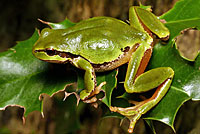 |
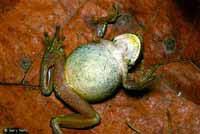 |
| Adult, Pierce County, Washington |
Adult, Multnomah County, Oregon |
Adult, Snohomish County, Washington
|
 |
|
|
|
Juvenile, 6,000 ft.,
Deschutes County, Oregon
|
|
|
|
| |
|
|
|
| Reproduction, Eggs, and Young |
 |
 |
 |
 |
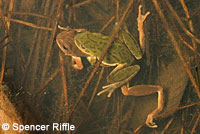
| Adults in amplexus, Humboldt County © Spencer Riffle |
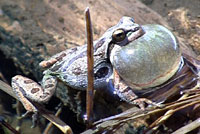
Adult male calling,
Kittitas County, Washington |
Calling adult male, Humboldt County
© Spencer Riffle |
 |
 |
 |
 |
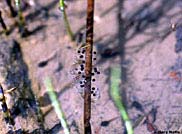
| Eggs, Lewis County, Washington |
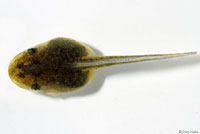
Young tadpole |
Tadpole |
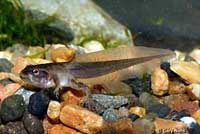
Mature tadpole with four legs, and developing pattern |
Look here for more pictures of Pacific Treefrog Eggs, Tadpoles, and Newly Transformed Frogs.
|
| Habitat |
 |
 |
 |
|
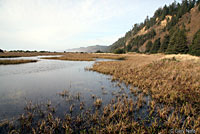
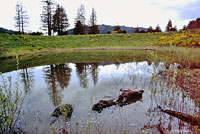
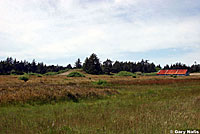
| Habitat, temporary pools on coastal plain, Humboldt County |
Habitat, Humboldt County |
Habitat, Del Norte County |
|
More pictures of this frog and its habitat in the Northwest are available on our Northwest Herps page.
|
| Short Videos |
 |
 |
 |
|
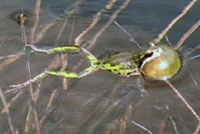
A male Pacific Treefrog calls while floating on a pond in the Cascades Mountains of Washington on a sunny Summer day. This is the two-part advertisement call.
|
A male Sierran Treefrog makes the one-part or enhanced call from the edge of a small temporary snow-melt pond at 8,600 feet elevation in Alpine County. This species is identical in sound and appearance to the Northern Pacific Treefrog. |
A male Pacific Treefrog on a pond in the Cascades Mountains of Washington responds to the frog-like sounds made by a human. When the human sounds are similar to the territorial call, the frog responds likewise. |
|
|
|
|
|
| Description |
| |
| Size |
Adults are .75 - 2 inches long from snout to vent (1.9 - 5.1 cm). (Stebbins, 2003)
|
| Appearance |
A small frog with a large head, large eyes, a slim waist, round pads on the toe tips, limited webbing between the toes, and a wide dark stripe through the middle of each eye that extends from the nostrils to the shoulders.
Legs are long and slender.
Skin is smooth and moist.
Often there is a Y-shaped marking between the eyes.
|
| Color and Pattern |
Dorsal body coloring is variable: green, tan, brown, gray, reddish, cream, but it is most often green or brown.
The underside is pale with yellow underneath the back legs.
Ability to Change Color
The dark eye stripe does not change, but the body color and dark markings can quickly change from dark to light, and the body color itself can also change, typically from brown to green or vice versa or a combination of both, in response to environmental conditions.
A study of Hyla (Pseuacris) regilla in Washington concluded that "H. regilla has control over and can change its hue, chroma, and lightness during time periods on the order of minutes." ..."...we support the idea that physiological color change has evolved as a mechanism to allow rapid background matching as a tree frog moves from one location to another."
(James C. Stegen et al. The control of color change in the Pacific tree frog, Hyla regilla. Canadian Journal of Zoology, 2004, Vol. 82, No. 6)
|
| Male/Female Differences |
| The male's throat is darkened and wrinkled. |
| Young |
| Similar to adults. |
| Larvae (Tadpoles) |
Tadpoles are up to 1 7/8 inches long ( 4.7 cm) blackish to dark brown and light below with a bronze sheen.
The intestines are not visible.
Viewed from above, the eyes extend to the outline of the head.
|
| Life History and Behavior |
| Activity |
Active both day and night, becoming mostly nocturnal during dry periods.
During wet weather, they move around in low vegetation. In locations at low elevations where temperatures are more moderate, frogs may be active all year. At colder or hotter locations, frogs avoid temperature extremes by hibernating in moist shelters such as dense vegetation, debris piles, crevices, mammal burrows, and even human buildings.
Pacific Treefrogs that were underground in the blast zone during the eruption of Mt. St. Helens were one of the few vertebrates to survive.
The name "treefrog" is not entirely accurate. This frog is chiefly a ground-dweller, living among shrubs and grass typically near water, but occasionally it can also be found climbing high in vegetation and on trees. Its large toe pads allow it to climb easily, and cling to branches, twigs, and grass.
Green body color absorbs more solar radiation which can be more beneficial in cold and aquatic habitats.
Brown body color absorbs less solar radiation, which may be more beneficial in drier, hotter, more terrestrial habitats. |
| Defense |
| When disturbed, this frog typically hops a large distance or jumps into the water and swims into vegetation to hide. But at times they will use their cryptic body color to avoid predation by remaining motionless. |
Territoriality
|
| Males are territorial during the breeding season, producing a slow trilled encounter call to warn other males. |
| Longevity |
| Not known. |
| Voice (Listen) |
Advertisement calls are heard during the evening and at night, and during the daytime at the peak of the breeding season.
Males produce two different kinds of very loud advertisement calls: a two-parted, or diphasic call, typically described as rib-it, or krek-ek, with the last syllable rising in inflection, and a one-part, or monophasic call, also called the enhanced mate attraction call.
They also produce a slow trilled encounter call, a release call, and a land call, which is a prolonged one-note sound that is produced much of the year, especially during the beginning of the fall rains.
The most commonly heard frog in its range.
(The call of the Baja California Treefrog is known throughout the world through its wide use as a nighttime background sound in old Hollywood movies, even those which are set in areas well outside the range of this frog. The call of the Baja California Treefrog is identical to that of the Sierran Treefrog and the Northern Pacific Treefrog, and it is possible that the calls any of these species were used as movie sound effects.) |
| Diet and Feeding |
Eats a wide variety of invertebrates, primarily on the ground at night, including a high percentage of flying insects.
During the breeding season, they also feed during the day.
Typical of most frogs, prey is located by vision, then the frog lunges with a large sticky tongue to catch the prey and bring it into the mouth to eat.
Tadpoles are suspension feeders, eating a variety of prey including algae, bacteria, protozoa and organic and inorganic debris. |
| Reproduction |
Reproduction is aquatic.
Fertilization is external, with the male grasping the back of the female and releasing sperm as the female lays her eggs.
The reproductive cycle is similar to that of most North American Frogs and Toads. Mature adults come into breeding condition and move to ponds or ditches where the males call to advertise their fitness to competing males and to females. Males and females pair up in amplexus in the water where the female lays her eggs as the male fertilizes them externally. The adults leave the water and the eggs hatch into tadpoles which feed in the water and eventually grow four legs, lose their tails and emerge onto land where they disperse into the surrounding territory.
Breeding and egg-laying occurs between November until July, depending on the location.
Adults probably become reproductively mature in their first year. Mature adults come into breeding condition and move to ponds or ditches where the males call to advertise their fitness to competing males and to females. These calls attract more males, then eventually females. Males call while in or next to water at night, and during daylight during the peak of breeding when calling can occur all day and night.
Males and females pair up in amplexus in the water where the female lays her eggs as the male fertilizes them externally. The adults leave the water and the eggs hatch into tadpoles which feed in the water and eventually grow four legs, lose their tails and emerge onto land where they disperse into the surrounding territory.
Some males and females have been observed staying only a few weeks at a breeding site. Some males have been observed moving to another site. And others have been observed staying at a site the entire breeding season.
Males are territorial during the breeding season, establishing territories that they will defend with an encounter call or by physically butting and wrestling with another male. Satellite male breeding behavior has been observed - a silent male will intercept and mate with females that are attracted to the calling of other territorial males.
Breeding locations include slow streams, permanent and seasonal ponds, reservoirs, ditches, lakes, marshes, shallow vegetated wetlands, wet meadows, forested swamps, potholes, artificial ponds, and roadside ditches. |
| Eggs |
Females lay on average between 400 - 750 eggs in small, loose, irregular clusters of 10 - 80 eggs each.
(Rorabaugh & Lannoo, Lannoo, 2005)
Egg clusters are attached to sticks, stems, or grass in quiet shallow water.
The eggs hatch in two to three weeks.
Eggs appear to be resistant to the negative effects of solar UV-B radiation and even to increased water acidification.
Eggs can also survive freezing temperatures for a short time.
|
| Tadpoles and Young |
Tadpoles aggregate for thermoregulation and to avoid predation.
Tadpoles metamorphose in about 2 to 2.5 months, generally from June to late August.
In summer, there are often large congregations of new metamorphs along the banks of breeding pools.
Metamorphosed juveniles leave their birth pond soon after transformation, dispersing into adult habitats.
|
| Habitat |
This species utilizes a wide variety of habitats, often far from water outside of the breeding season, including forest, woodland, chaparral, grassland, pastures, desert streams and oases, underground caves, and urban areas.
|
| Geographical Range |
Possible Distribution in California
The range of this species is not clear, due to the small number of specimens sampled for the study that described it as a new species in 2006, and the lack of localities listed. (The only specific locality for this species in the 2006 Recuero et al study is Clark Fork River, Missoula Co., Montana.) It is tentatively shown here on the far northwest coast of California in Humboldt and Del Norte counties. (The southern contact zone with Pseudacris sierra is unclear. According to the U.S.G.S. online
account, this species occurs north of southwest Oregon, and does not occur in California.)
Distribution Outside California
Outside of California, P. regilla ranges through most of western Oregon, western Washington and southwest British Columbia, Canada, including Vancouver Island.
Nonindigenous Populations Outside California
P. regilla has been introduced into Alaska and the Haida Gwaii (Queen Charlotte) Islands off the coast of British Columbia.
S.O. MacDonald The Amphibians and Reptiles of Alaska. A Field Handbook, 2010, mentions that tadpoles and transforming frogs of this species that were collected in Washington state and introduced into a pond system on Revillagigedo Island, Alaska, were still extant in 2002.The source of introduction in Canada was not mentioned. (The link for this source has been removed.)
The Alaska Center for Conservation Science website description of P. regilla shows several locations for this species in Alaska, near Ketchikan and near Juneau.
(The link for this source has been removed.)
Nonindiginous populations of P. regilla occur in Arizona in the Virgin Mountains and in plant nurseries in Phoenix and Tucson (Brenenan and Holycross 2006).
(P. regilla was split into three species, but which species occurs in Arizona is not known.)
|
 |
| Elevational Range |
The former species Pseudacris regilla ranged from sea level to (11,600 ft) in the Sierra Nevada Mountains (3,536 m.) (Rorabaugh and Lannoo - Amphibiaweb).
|
| Notes on Taxonomy |
Genus changed from Hyla to Pseudacris
The Generic name of this species was changed from Hyla (Treefrogs) to Pseudacris (Chorus Frogs). This creates confusion when some continue to use the long-used common name Treefrog, even though Chorus Frog is more accurate. Most authorities show the common name as either Treefrog or Chorus Frog, which I do here.
----------------------------------------------------------------------------------------------------------------------------------------------------------------------------------------------------------------------------
"We (actually the Society for the Study of Amphibians and Reptiles, the Herpetologists' League, and the American Society of
Ichthyologists and Herpetologists) have decided it best to call our local loud mouths, the Pacific Treefrog, Pseudacris regilla.
So, we're going to acknowledge that the species is not a treefrog, it's a chorus frog. But, we're going to concede that the vernacular doesn't have to be an accurate reflection of phylogeny and go with the traditional, well-recognized name, Pacific Treefrog." Kelly McAllister, Washington Department of Fish and Wildlife
----------------------------------------------------------------------------------------------------------------------------------------------------------------------------------------------------------------------------
The naming of this frog has been confusing for years, and in 2006 it got even more confusing when one species of frog was split into three species (see the information directly below.) I am using this three species taxonomy on this website because it has been adopted by some reputable Herpetological associations, but it is still not universally accepted. Some herpetologist believe that it is not accurate because there are no obvious differences in appearance or in the advertisement calls between the three species of frogs.
----------------------------------------------------------------------------------------------------------------------------------------------------------------------------------------------------------------------------
One species (Pseudacris regilla) becomes three species:
In 2006 Recuero et al published evidence that Pseudacris regilla is actually made up of 3 species. However, they assigned names to two of the species which they later determined were incorrect. The three species were correctly named in a followup paper.
((Recuero, Ernesto, Íñigo Martínez-Solano, Gabriela Parra-Olea, Mario García-París. Phylogeography of Pseudacris regilla (Anura: Hylidae) in western North America, with a proposal for a new taxonomic rearrangement 2006 Molecular Phylogenetics and Evolution 39: 293-304
Recuero, Ernesto, Íñigo Martínez-Solano, Gabriela Parra-Olea, Mario García-París. Corrigendum to ‘‘Phylogeography of Pseudacris regilla (Anura: Hylidae) in western North America, with a proposal for a new taxonomic rearrangement’’ [Mol. Phylogenet. Evol. 39 (2006) 293–304]
Molecular Phylogenetics and Evolution. 41(2): pp. 511.))
The names they gave these three species are:
Pseudacris regilla - Northwest Chorus Frog
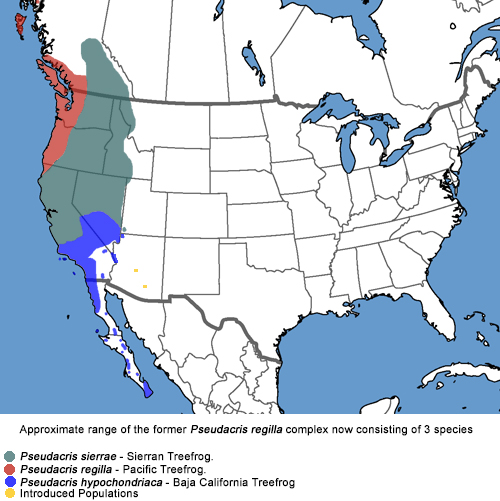
This is the northern clade, ranging along the north coast from approximately Humboldt County north into parts of Oregon and Washington.
Pseudacris sierra - Pacific Chorus Frog
This is the central clade, ranging approximately from Humboldt County south to Santa Barbara, and east into the Sierras, and the Northcentral, and Northeast part of the state, including Shasta County, and into Nevada, Eastern Oregon, Idaho and Montana.
Pseudacris hypochondriaca - Baja California Chorus Frog
This is the southern clade, ranging approximately from Santa Barbara south throughout Baja California, east to Bakersfield, Beatty, and southern Inyo County. This species is comprised of two subspecies, P. h. curta, which occurs in Baja California, and P. h. hypochondriaca, which occurs in California.
The authors do not provide detailed maps or descriptions of the ranges of the three species and they do not describe the contact zones between the species. They also do not provide any locality information for P. regilla, leaving me to consult previous work on the former subspecies Pseudacris regilla pacifica. This makes it hard to determine where these species occur in the state.
The dark spots on the following map are the approximate localities of the small sample of specimens used in the study. The colored areas are a guess at the range of each species. According a range map put online by the U.S.G.S., P. regilla does not even occur in California, but I have included it on my map because I believe the old subspecies P. r. pacifica ranged south along the north coast to Humboldt County, though I have no reference yet to back that up. It is possible that the species does not occur in California. Obviously, much more research is needed on these three species. |
 |
--------------------------------------------------------------------------------------------------------------------------------------------------------------------------------------------------------------------------
The 2017 SSAR Herpetological Circular No. 43 (scientific and standard English names of amphibians and reptiles of North America north of Mexico) comments that
the three species may once again be regarded as only one species, Pseudacris regilla: "Barrow et al. (2014, Mol. Phylogenet. Evol. 75: 78–900) suggested that the distinction of P. hypochondriaca and P. sierra, drawn on the basis of mtDNA, was not supported by nDNA analysis. This suggests that this taxon will ultimately be included in the synonymy of Pseudacris regilla."
----------------------------------------------------------------------------------------------------------------------------------------------------------------------------------------------------------------------------
Genus Hyliola
In a paper published April 2016 * William E. Duellman, Angela B. Marion & S. Blair Hedges present a new phylogenetic tree of hylid frogs (Family Hylidae Rafinesque, 1815) that consists of three families, nine subfamilies, and six resurrected generic names and five new generic names. The family Hylidae contains 7 subfamiles, based on molecular information, not necessarily morphologic characters. Using this tree, the four hylid species found in California become part of the subfamily Acridinae (Acridinae Mivart, 1869) which contains two genera, Pseudacris, and Hyliola (Hyliola Mocquard, 1899.) Our treefrogs (formerly placed in the genus Pseudacris) are placed in the genus Hyliola:
Hyliola cadaverina (Cope),
Hyliola hypochondriaca (Hallowell),
Hyliola regilla (Baird and Girard) &
Hyliola sierra (Jameson, Mackey, and Richmond.)
* William E. Duellman, Angela B. Marion & S. Blair Hedges. Phylogenetics, classification, and biogeography of the treefrogs (Amphibia: Anura: Arboranae)
Zootaxa 4104 (1): 001–109 http://www.mapress.com/j/zt/ Copyright © 2016 Magnolia Press.
Hansen and Shedd (2025) use Psedudacris with this comment: "...Duellman et al. (2016) recommended moving California species [of hylid frogs] to a third genus, Hyliola, based on their geographic separation from eastern members of Pseudacris, a move we find unnecessary and needlessly disruptive of now-established taxonomy. We follo wth reasoning of Faivovich et al. (2018) and Banker et al. (2020) in retaining use of Pseudacris."
Amphibiaweb (accessed January, 2025) uses the genus Pseudacris with the subgenus Hyliola.
Nicholson, K. E. (ed.). 2025 SSAR Scientific and Standard English Names List comment: on Hyliola
"Based on a re-analysis of previously published molecular data, Duellman et al. (2016, Zootaxa 4104: 1–109) restricted the name Pseudacris to the eastern and Rocky Mountain species related to P. nigrita and allocated the western species, P. cadaverina, P. hypochondriaca, P. regilla, and P. sierra to Hyliola Mocquard, 1899. Based on genome-wide nDNA data, Banker et al. (2020, Systematic Biology 69: 756–773) argued that Hyliola should not be recognized because (a) the genus Pseudacris already is a monophyletic taxon without the change, and (b) the geographic separation rationale cited by Duellman et al. (2016, Zootaxa 4104: 1–109) is insufficient as the sole criterion for splitting a long-recognized monophyletic clade, causing unnecessary taxonomic instability. Use of Hyliola has not gained any traction in the systematic community, presumably because of the small number of species involved." |
| |
Alternate and Previous Names (Synonyms)
The Genus of this species was changed from Hyla (Treefrogs) to Pseudacris (Chorus Frogs). This creates confusion when some continue to use Treefrog because it has been used for many years (as I do here, following the SSAR) while others use Chorus Frog, which is actually more accurate.
(See comments directly above on the use of yet another new genus Hyliola.)
Pseudacris regilla - Pacific Chorus Frog (Hansen and Shedd 2025)
Pseudacris regilla - Pacific Chorus Frog (McGinnis & Stebbins 2018)
Hyliola regilla (Duellman, Marion, & Hedges 2016)
Pseudacris regilla - Pacific Chorus Frog (Pacific Treefrog) (Stebbins & McGinnis 2012)
Hyla regilla - Pacific Treefrog (Stebbins 1966, 1985)
Hyla regilla - Pacific Tree-Frog (Stebbins 1954)
Hyla regilla - Pacific Tree Frog (Pacific Tree Toad, Pacific Hyla, Wood Frog, Pacific Coast Tree Toad) (Wright & Wright 1949)
Hyla regilla - Pacific Tree-toad (Storer 1925)
Hyla regilla - Pacific Tree-frog - Western Tree-frog, Wood-frog, Pacific Hyla, Tree-toad, Cadaverous Hyla, Greeny, Cape San Lucas Hyla (Litoria occidentalis; Hyla scapularis; Hyla nebulosa; Hyla scapularis var. hypochondriaca; Hyla cadaverina; Hyla regilla var. scapularis) (Grinnell and Camp 1917)
Hyla curta (Van Denburgh 1905)
Hyla scapularis (Hallowell 1854)
Hyla nebulosa (Hallowell 1854)
Hyla regilla (Baird & Girard 1852)
|
| Conservation Issues (Conservation Status) |
This species is not considered to be declining in population.
Tadpoles are sensitive to nitrites and excess nitrite concentrations from agricultural runoff could cause them harm.
Diseases, pollution, parasites, and non-native predators can all be a threat to all frogs.
More information about frog deformities and malformations.
Pacific Treefrogs have been found in Christmas trees shipped from Washington State to Anchorage Alaska, where there is no requirement to shake the trees when they are imported to remove stowaway species. Wildlife officials in the state are suggesting that residents who find frogs bring them in or euthanize them. (Anchorage Daily News, 12/18/09.)
|
|
| Taxonomy |
| Family |
Hylidae |
Treefrogs |
Laurenti, 1768 |
| Genus |
Pseudacris |
Chorus Frogs |
Fitzinger, 1843 |
| Species |
regilla |
Pacific Treefrog
|
(Baird and Girard, 1852) |
| Original Description |
Hyla or Pseudacris regilla (Baird and Girard, 1852) - Proc. Acad. Nat. Sci. Philadelphia, Vol. 6, p. 174
Recuero, Martinez-Solano, Parra-Olea, and García-París, 2006
from Original Description Citations for the Reptiles and Amphibians of North America © Ellin Beltz
|
| Meaning of the Scientific Name |
Pseudacris
Greek - pseudes = false, deceptive +
Greek - akris = locust
[Acris is also the genus of Cricket Frogs, which make a sound similar to a locust, so the name probably refers to this frog's call, which could be heard as similar to the sounds of locusts or Cricket Frogs.]
regilla
- Latin -=regal, splendid - probably referring to the markings
from Scientific and Common Names of the Reptiles and Amphibians of North America - Explained © Ellin Beltz
|
| Related or Similar California Frogs |
Pseudacris hypochondriaca - Baja California Treefrog
Pseudacris sierra - Sierran Treefrog
|
| More Information and References |
U. S. Geological Survey (With maps and information about the 3 species split of the former Pseudacris regilla species.)
California Department of Fish and Wildlife
AmphibiaWeb
Hansen, Robert W. and Shedd, Jackson D. California Amphibians and Reptiles. (Princeton Field Guides.) Princeton University Press, 2025.
Stebbins, Robert C., and McGinnis, Samuel M. Field Guide to Amphibians and Reptiles of California: Revised Edition (California Natural History Guides) University of California Press, 2012.
Stebbins, Robert C. California Amphibians and Reptiles. The University of California Press, 1972.
Flaxington, William C. Amphibians and Reptiles of California: Field Observations, Distribution, and Natural History. Fieldnotes Press, Anaheim, California, 2021.
Nicholson, K. E. (ed.). 2025. Scientific and Standard English Names of Amphibians and Reptiles of North America North of Mexico, with Comments Regarding Confidence in Our Understanding. Ninth Edition. Society for the Study of Amphibians and Reptiles. [SSAR] 87pp.
Samuel M. McGinnis and Robert C. Stebbins. Peterson Field Guide to Western Reptiles & Amphibians. 4th Edition. Houghton Mifflin Harcourt Publishing Company, 2018.
Stebbins, Robert C. A Field Guide to Western Reptiles and Amphibians. 3rd Edition. Houghton Mifflin Company, 2003.
Behler, John L., and F. Wayne King. The Audubon Society Field Guide to North American Reptiles and Amphibians. Alfred A. Knopf, 1992.
Robert Powell, Roger Conant, and Joseph T. Collins. Peterson Field Guide to Reptiles and Amphibians of Eastern and Central North America. Fourth Edition. Houghton Mifflin Harcourt, 2016.
Powell, Robert., Joseph T. Collins, and Errol D. Hooper Jr. A Key to Amphibians and Reptiles of the Continental United States and Canada. The University Press of Kansas, 1998.Corkran, Charlotte & Chris Thoms. Amphibians of Oregon, Washington, and British Columbia. Lone Pine Publishing, 1996.
Jones, Lawrence L. C. , William P. Leonard, Deanna H. Olson, editors. Amphibians of the Pacific Northwest. Seattle Audubon Society, 2005.
Leonard et. al. Amphibians of Washington and Oregon. Seattle Audubon Society, 1993.
Nussbaum, R. A., E. D. Brodie Jr., and R. M. Storm. Amphibians and Reptiles of the Pacific Northwest. Moscow, Idaho: University Press of Idaho, 1983.
American Museum of Natural History - Amphibian Species of the World 6.2
Bartlett, R. D. & Patricia P. Bartlett. Guide and Reference to the Amphibians of Western North America (North of Mexico) and Hawaii. University Press of Florida, 2009.
Elliott, Lang, Carl Gerhardt, and Carlos Davidson. Frogs and Toads of North America, a Comprehensive Guide to their Identification, Behavior, and Calls. Houghton Mifflin Harcourt, 2009.
Lannoo, Michael (Editor). Amphibian Declines: The Conservation Status of United States Species. University of California Press, June 2005.
Storer, Tracy I. A Synopsis of the Amphibia of California. University of California Press Berkeley, California 1925.
Wright, Albert Hazen and Anna Wright. Handbook of Frogs and Toads of the United States and Canada. Cornell University Press, 1949.
Davidson, Carlos. Booklet to the CD Frog and Toad Calls of the Pacific Coast - Vanishing Voices. Cornell Laboratory of Ornithology, 1995.
Recuero, Ernesto, Íñigo Martínez-Solano, Gabriela Parra-Olea, Mario García-París. Phylogeography of Pseudacris regilla (Anura: Hylidae) in western North America, with a proposal for a new taxonomic rearrangement 2006 Molecular Phylogenetics and Evolution 39: 293-304
Recuero, Ernesto, Íñigo Martínez-Solano, Gabriela Parra-Olea, Mario García-París. Corrigendum to ‘‘Phylogeography of Pseudacris regilla (Anura: Hylidae) in western North America, with a proposal for a new taxonomic rearrangement’’ [Mol. Phylogenet. Evol. 39 (2006) 293–304]
Molecular Phylogenetics and Evolution. 41(2): pp. 511.
Brennan, Thomas C., and Andrew T. Holycross. Amphibians and Reptiles in Arizona. Arizona Game and Fish Department, 2006.
Joseph Grinnell and Charles Lewis Camp. A Distributional List of the Amphibians and Reptiles of California. University of California Publications in Zoology Vol. 17, No. 10, pp. 127-208. July 11, 1917.
|
|
|
The following conservation status listings for this animal are taken from the April 2024 State of California Special Animals List and the April 2024 Federally Listed Endangered and Threatened Animals of California list (unless indicated otherwise below.) Both lists are produced by multiple agencies every year, and sometimes more than once per year, so the conservation status listing information found below might not be from the most recent lists. To make sure you are seeing the most recent listings, go to this California Department of Fish and Wildlife web page where you can search for and download both lists:
https://www.wildlife.ca.gov/Data/CNDDB/Plants-and-Animals.
A detailed explanation of the meaning of the status listing symbols can be found at the beginning of the two lists. For quick reference, I have included them on my Special Status Information page.
If no status is listed here, the animal is not included on either list. This most likely indicates that there are no serious conservation concerns for the animal. To find out more about an animal's status you can also go to the NatureServe and IUCN websites to check their rankings.
Check the current California Department of Fish and Wildlife sport fishing regulations to find out if this animal can be legally pursued and handled or collected with possession of a current fishing license. You can also look at the summary of the sport fishing regulations as they apply only to reptiles and amphibians that has been made for this website.
This frog is not included on the Special Animals List, meaning there are no significant conservation concerns for it in California according to the Dept. of Fish and Game.
|
| Organization |
Status Listing |
Notes |
| NatureServe Global Ranking |
|
|
| NatureServe State Ranking |
|
|
| U.S. Endangered Species Act (ESA) |
None |
|
| California Endangered Species Act (CESA) |
None |
|
| California Department of Fish and Wildlife |
None |
|
| Bureau of Land Management |
None |
|
| USDA Forest Service |
None |
|
| IUCN |
|
|
|
|
|