|
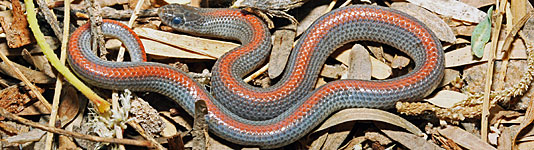
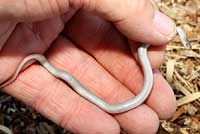
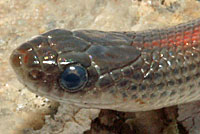
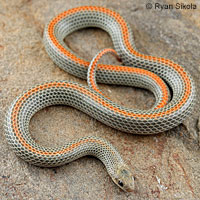
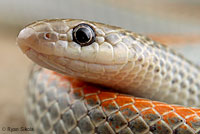
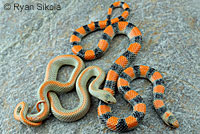
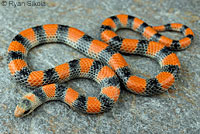
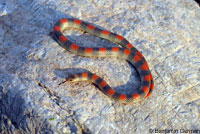
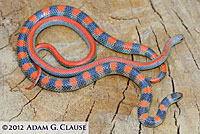
As the common name of this subspecies indicates, the Western Groundsnake is not consistent in pattern and color. The pictures below have been divided into four different morphs.
|
Orange-Striped Morph |
 |
 |
 |
 |
| |
Juvenile, Imperial County |
|
| |
 |
|
| |
Juvenile, Imperial County |
|
 |
 |
 |
| Adult, Inyo County © Ryan Sikola |
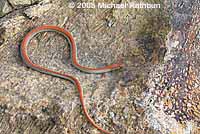
Adult, Old Woman Mtns.
San Bernardino County
© 2005 Michael Rathbun. |
 |
 |
 |
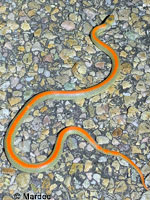
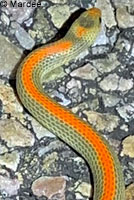
Adult, Inyo County © Mardee
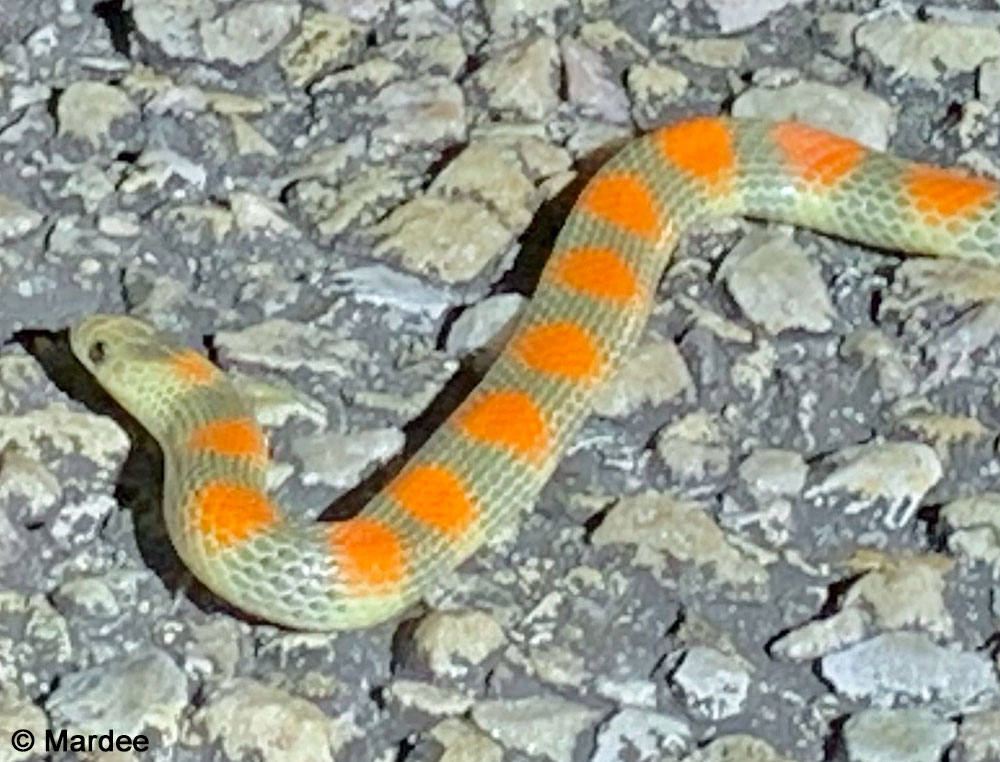
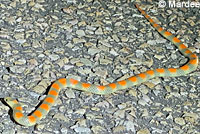
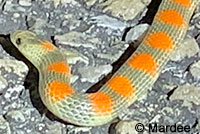
Another groundsnake with the same coloring as this one but with bright orange saddles instead of a stripe was also found in the same area. (Shown below)
|
Adult, Old Woman Mountains,
San Bernardino County
© Jeremiah Easter |
| |
|
|
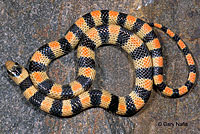
Orange-Striped Black-Banded Morph |
 |
 |
 |
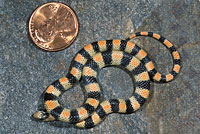
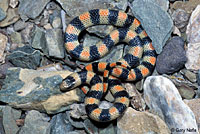
Striped and banded adults, Inyo Couty
© Ryan Sikola |
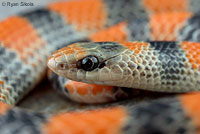
Adult, Inyo Couty © Ryan Sikola |
 |
 |
 |
| Adult, Inyo County |
Adult, Inyo County |
 |
 |
 |
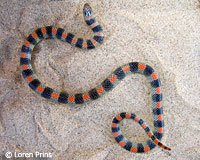
Adult, Lassen County
(First snake recorded from from Lassen County and Northeastern California.)
© Loren Prins
|
Adult, Inyo County
© Brad Alexander |
Adult, Clark Mountains, San Bernardino County. © Benjamin German |
 |
 |
 |
Striped adult male and banded adult female, San Bernardino County
© Adam G. Clause |
Adult, Inyo County © Mardee
This aberrant adult missing black pigment was found near another groundsnake with more typical coloring. Another groundsnake with the same coloring as this one but with an orange stripe instead of saddles was also found in the same area.
(Shown above.)
|
 |
 |
 |
| Juvenile with faint orange stripe, Mono County © 2026 Jeremiah Easter |
 |
 |
 |
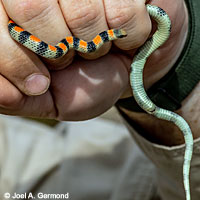
Juvenile and habitat, Mono County
© 2026 Jeremiah Easter |
Adult, showing partial dark banding of the underside, eastern San Bernardino County desert © Joel A. Germond |
Shed Groundsnake Skin, Inyo County |
| |
|
|
Banded Morph |
 |
 |
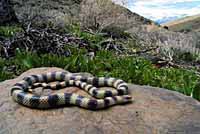 |
Adult, Riverside County
© Jeremiah Easter |
Underside of the Riverside County snake shown to the left, showing the dark bands circling the body.
© Jeremiah Easter |
Adult, Inyo County
© 2005 Jeremiah Easter |
 |
 |
 |
| Adult found active in daylight in the Riverside County desert © Tom Mills |
 |
 |
|
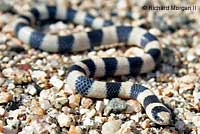
| Adult, Riverside County © Richard Morgan II |
|
 |
 |
|
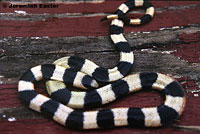
Preserved specimen from San Bernardino County near Joshua Tree.
The picture on the right shows the underside with the dark bands circling the body.
© Jeremiah Easter |
|
| |
|
|
Variable Groundsnakes From Outside California |
| |
|
|
Unicolor Morph |
 |
 |
 |
| |
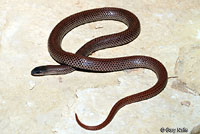
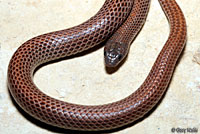
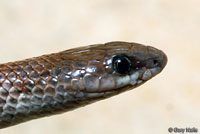
Adult, Presidio County, Texas |
|
| |
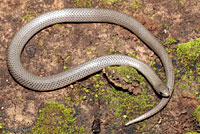
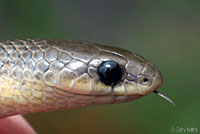
| (The unicolor Groundsnakes shown below have been tentatively described as the species Sonora episcopa.) |
 |
 |
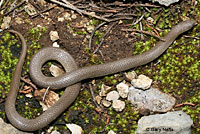 |
| Adult, Travis County, Texas |
Adult, Travis County, Texas |
| |
|
|
| (The unicolor Groundsnakes shown below have been tentatively described as Sonora mosaueri) |
 |
 |
|
| Adult, Los Cabos, Baja California Sur © Ivan Vershynin |
|
| |
More Western Groundsnakes From Outside California |
 |
 |
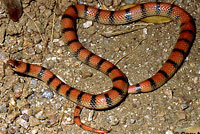 |
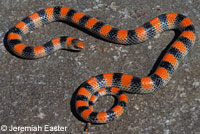
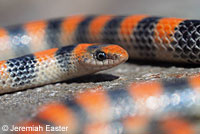
| Orange-striped black-banded adult, Washoe County, Nevada © Jeremiah Easter |
Orange-striped black-banded adult, Arizona© Gary Nafis, specimen courtesy of Randy Babb |
| |
|
|
| |
Wide orange-striped adult, Arizona,
© Gary Nafis, specimen courtesy of Randy Babb |
|
| |
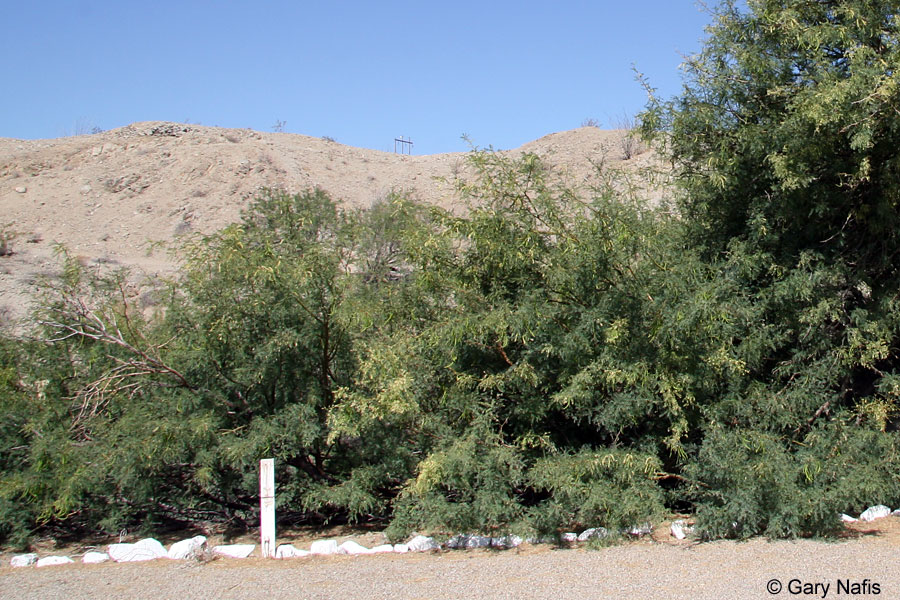
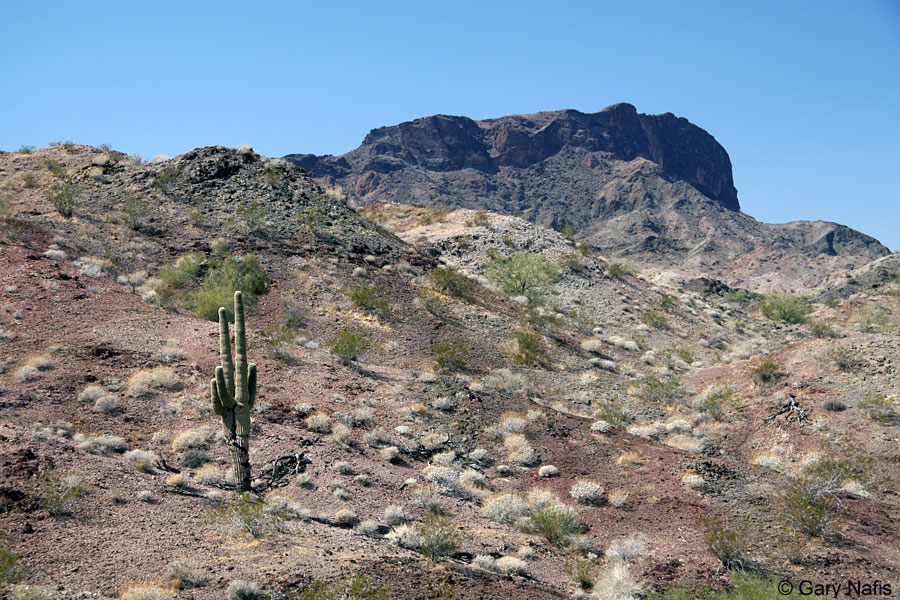
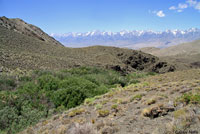
| Habitat |
 |
 |
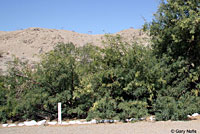 |
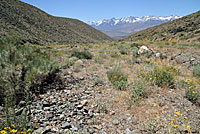
Habitat, rocky wash, 5,500 ft.,
Inyo County mountains
|
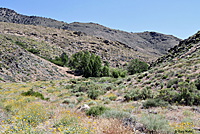
Habitat, White/Inyo Mountains,
Inyo County |
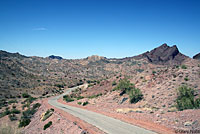
Habitat, next to Colorado River, Imperial County desert |
 |
 |
 |
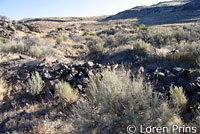
Habitat, Lassen County desert
© Loren Prins |
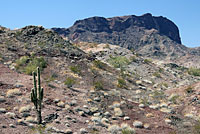
Habitat, Whipple Mountains, San Bernardino County |
 |
 |
 |
Desert Riparian Habitat,
Inyo Mountains, Inyo County
|
Habitat, Amargosa Mountains, Inyo county © Jeremiah Easter |
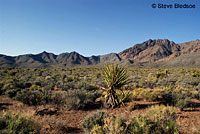
A Groundsnake was found at a spring in the Kingston Mountains, seen here in the background, in San Bernardino County.
© Steve Bledsoe |
| |
|
|
| Short Video
|
| |
 |
|
| |
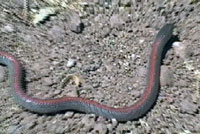
A tiny juvenile Variable Ground Snake is found under a rock in Imperial County. |
|
| |
|
|
| Similar Sympatric Snakes |
 |
 |
 |
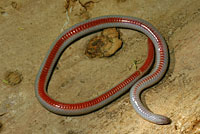
Comparison chart of the 3 subspecies of Chionactis in California, along with the similar sympatric species - Sonora semiannulata, and the similar possibly sympatric species - Chilomeniscus stramineus.
A plain-colored Variable Ground Snake with black on the head is sometimes confused with a Smith's Black-headed Snake - Tantilla hobartsmithi, but the ground snake has a loreal scale, which is not present in Tantilla, and lacks the red coloring on the belly that is found on the black-headed snake.
|
|
 |
 |
Underside of striped morph
Variable Groundsnake |
Underside of
Southwestern Black-headed Snake |
Underside of
Shovel-nosed Snake |
|
|
|
Underside of orange-striped black banded morphVariable Groundsnake
© Jeremiah Easter |
|
|
|
|
Description |
Not Dangerous - This snake does not have venom that can cause death or serious illness or injury in most humans.
Commonly described as "harmless" or "not poisonous" to indicate that its bite is not dangerous, but "not venomous" is more accurate. (A poisonous snake can hurt you if you eat it. A venomous snake can hurt you if it bites you.)
There are shallow grooves on the outer sides of the rear teeth which indicates that this snake may produce a mild venom that is not dangerous to humans, but this has not been studied.
|
| Size |
Adults are typically 8 - 18 inches long (20.3 - 46 cm) (Stebbins, 2003.)
|
| Appearance |
A small snake with a round body, smooth glossy scales, and a head barely wider than the neck.
|
| Color and Pattern |
Like the common name says, this snake is polymorphic - it occurs in several different forms with varying colors and patterns.
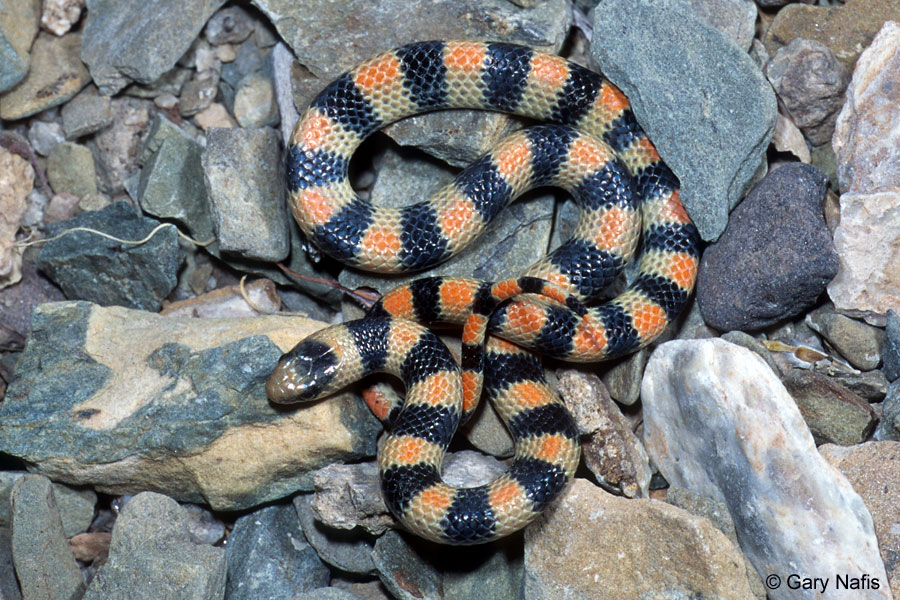
The body can be striped, banded, or banded with orange or yellow coloring on top of the back.
The ground color can be brown, gray, orange, reddish, or olive.
The ground color, the color of the head cap, the width of the stripes, and the amount of orange on top are all highly variable. Some snakes appear to have black and orange (or yellow) bands, while others show only a faint amount of orange on top of the back.
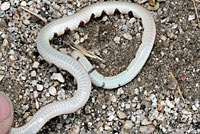
The underside can be whitish or yellowish with or without dark crossbands.
Four different morphs have been recognized, with variations within, and there may be more:
- orange-striped (with very thin to very wide stripes)
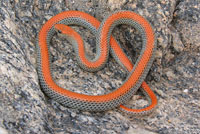
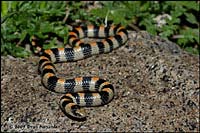
- orange-striped-black banded (the orange coloring is on the top part of the body only, while the black bands extend to the venter. Sometimes the top coloring is yellow. This has also been called black-and-orange banded when the orange color fills the spaces between the black bands.
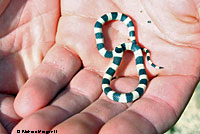
- banded (typically with black and white bands, sometimes the dark bands are rings that circle the entire body.)
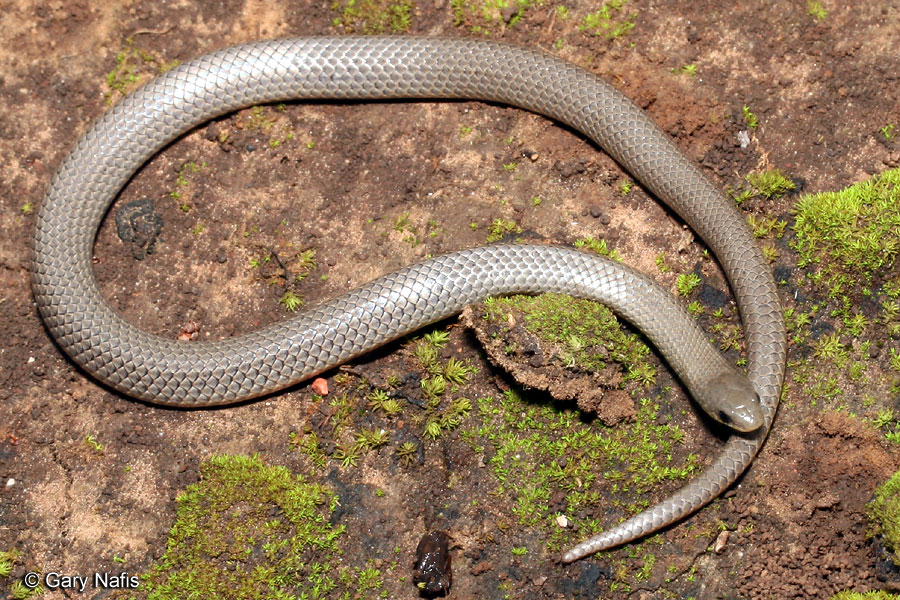
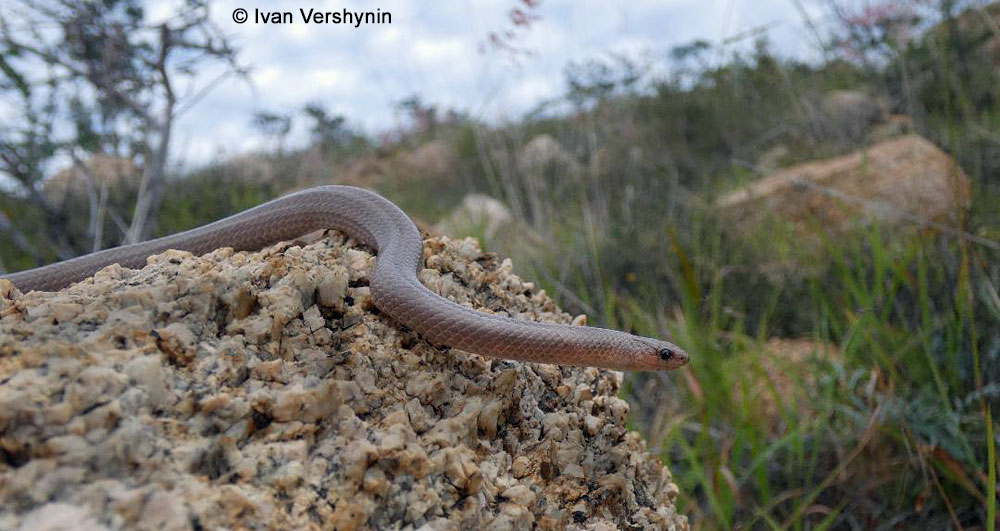
- unicolor (or uniform) - a solid brown, tan, or gray, sometimes white or orange. (This form has not yet been found in California, but it is present nearby in western Arizona and Baja California.)
These markings do not vary between sexes or change with age.
Some examples of the various colors and patterns found in these morphs are:
- banded with black and gray or yellowish with or without reddish saddles along the back on the light bands
- solid gray or brown with a darker head
- banded with orange or red and black
- banded with white and black
- banded with pink and gray
- reddish-orange above with gray sides
- gray with a thin orange stripe along the back
While the species is variable in color and pattern, and imultiple forms can be found at some localities, it appears that there could be a general geographical distribution of the three different forms found in California. This has not been documented in print anywhere that I have found, but personal communications and observations on iNaturalist appear to show it. I'm just speculating here, based on a small amount of evidence, so please let me know if you know of any evidence that contradicts this:
- Groundsnakes from the Chuckwalla Mountains and Joshua Tree area north to Barstow are banded, light in color with dark bands that extend around the underside;
- Groundsnakes in the southeast part of the range in California are striped (Imperial County and the lower Colorado River area to approximately Death Valley where the striped-banded form is also found);
- Groundsnakes in the northern part of the range in California are banded with various degrees of striping. (Some striped-banded snakes in the Death Valley area have a bright yellow ground color.)
|
| Life History and Behavior |
Very little is known about the natural history and distribution of this infrequently observed fossorial species.
Activity |
Secretive but not uncommon.
Can be active any time of day or night. Desert populations become primarily nocturnal in hot months.
Becomes dormant in cold months, roughly November into February.
Terrestrial, often remaining underground in the daytime, surfacing at night or during heavy rains.
Sometimes seen on roads at night, often discovered beneath surface debris, especially rocks. |
| Diet and Feeding |
| Eats small invertebrates, including spiders, scorpions, centipedes, crickets, and insect larvae. |
| Predation |
| Ground snakes are probably consumed by various vertebrates, including snakes, mammals, and birds, and maybe large lizards, but their predators also include invertebrates: A large Scolopendra heros centipede was observed killing then eating a Ground Snake in Texas. (Herpetological Review 38(1), 2007) |
| Reproduction |
Mating takes place in May and early June.
Females are oviparous, laying eggs underground from late May to August.
Females have been observed laying from 1 - 6 eggs.
Incubation lasts about 60 days.
(Bartlett & Tennant, 2000)
|
| Habitat |
Inhabits areas with surface cover and some moisture: grassland, river bottoms, desert flats, ranch land, sand hummocks, open rocky hillsides with loose soil, sandy washes, dry stream beds, and riparian thickets.
|
| Geographical Range |
In California, this species occurs from eastern San Diego county east to the Colorado River, north into the Mojave Desert as far west as 29 palms and Barstow, and north along the eastern slopes of the Sierra Nevada Mountains to Nevada, and farther north in Lassen County.
The first record from Northeastern California and from Honey Lake Basin in Lassen County was described in Herpetological Review 38(4), 2007, and can be seen in a photo above taken by Loren Prins, who made the discovery.
In March, 2026, Jeremiah Easter documented a snake found in Mono County in the eastern foothills of the White Mountains north of Inyo County and west of Nevada, which you can see in the photos above. It appears to be the first record for Mono county, although the species has been shown to inhabitat that area on old California range maps.
Outside of California, the species ranges north into Nevada, Oregon, and Idaho, extreme southeast Utah, Arizona, New Mexico, Texas, Oklahoma, Colorado, Arkansas, Missouri, and Kansas, and south into Mexico, including much of Baja California.
|
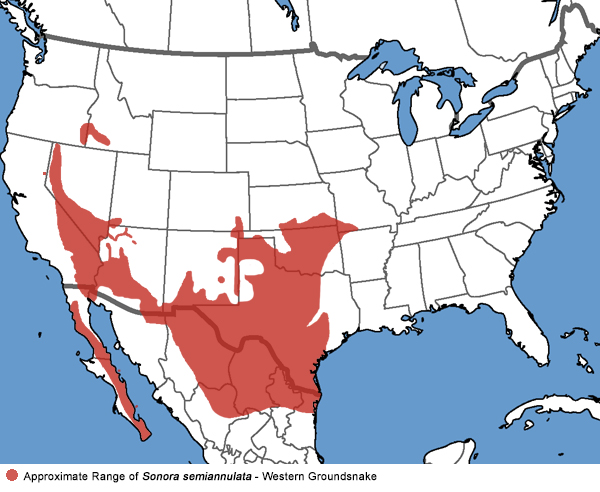
(Several subspecies are sometimes recognized, but I don't know their exact ranges outside of California.)
|
| Elevational Range |
Occurs from sea level to about 6,000 feet (1,830 m) elevation. (Stebbins & McGinnis, 2018)
|
| Notes on Taxonomy |
Several subspecies were once thought to exit based on the different pattern and color morphs found in this species, but when it was observed that several morphs were often found at the same location, this was considered inaccurate.
Cox et al in their April 2018 paper "Synopsis and taxonomic revision of three genera in the snake tribe Sonorini," synonymized genera Chilomeniscus and Chionactis with genus Sonora. They did not discuss common names changes.
If their taxomomy is accepted:
* Sonora semiannulata semiannulata becomes Sonora semiannulata;
* Chionactis occipitalis becomes Sonora occipitalis;
* Chionactis annulata annulata becomes Sonora occipitalis;
* Chilomeniscus stramineus, where possibly present in California, becomes Sonora cincta.
(Synopsis and taxonomic revision of three genera in the snake tribe Sonorini.
Christian L. Cox, Alison R. Davis Rabosky, Iris A. Holmes, Jacobo Reyes-Valasco, Corey E. Roelke, Eric N. Smith, Oscar Flores-Villela, Jimmy A. GcGuire and Jonathan A. Campbell.
Journal of Natural History, 2018 Vol. 52, Nos. 13-16, 945-988.
https://doi.org/10.1080/00222933.2018.1449912)
---------------------------------------------------------------------------------------------------------------------------------------------------------------------
Although most subspecies of Sonora are no longer recognized, the most current (2017) SSAR Standard English Names checklist continues to recognize two subspecies:
S. s. semiannulata Baird and Girard, 1853—Variable Groundsnake
S. s. taylori (Boulenger, 1894)—Southern Texas Groundsnake
---------------------------------------------------------------------------------------------------------------------------------------------------------------------
"Taxonomy follows Cox et al. (2018, Journal of Natural History 52: 945–988). Cox et al. (op. cit.) used mt- and nDNA data to produce a phylogeny in which Chilomeniscus and Chionactis are paraphyletic with respect to Sonora. Their phylogeny also recommends modification of species content through resurrection and elevation of several taxa: Sonora cincta, S. episcopa, S. taylori."
(Nicholson, K. E. (ed.). 2025 SSAR Scientific and Standard English Names List)
---------------------------------------------------------------------------------------------------------------------------------------------------------------------
Alternate and Previous Names (Synonyms)
Sonora semiannulata - Western Ground Snake (Nicholson, K. E. (ed.). 2025 SSAR Scientific and Standard English Names List)
Sonora semiannulata - Western Ground Snake (Stebbins 1966, 1988, 2003, 2012)
Sonora semiannulata - Western Ground Snake (2 subspecies in CA - S. a. isozona; S. a. linearis) (Stebbins, 1954)
S. s. isozona - Bicolored ground snake (Woodbury 1928)
S. s. linearis - Striped ground snake (Van Denburgh 1922)
Sonora episcopa - Texas Ground Snake (Lamprosoma episcopum)
Ringed ground snake
Banded ground snake;
Banded miter snake (refers to the head marking looking like a bishop's miter);
Bicolor ground snake;
Black banded ground snake;
Miter snake;
Pinkish ground snake;
Sonora ring snake;
Striped ground snake;
Vermilion ground snake;
Western earth snake
Vermilion-lined ground snake
Striped earth snake
Vermilion-striped ground snake
|
| Conservation Issues (Conservation Status) |
| None |
|
| Taxonomy |
| Family |
Colubridae |
Colubrids |
Oppel, 1811 |
| Genus |
Sonora |
North American Groundsnakes |
Baird and Girard, 1853 |
| Species |
semiannulata |
Western Groundsnake |
Baird and Girard, 1853 |
Subspecies
|
semiannulata |
Variable Groundsnake |
Baird and Girard, 1853 |
|
Original Description |
Sonora semiannulata - Baird and Girard, 1853 - Cat. N. Amer. Rept., Pt. 1, p. 117
from Original Description Citations for the Reptiles and Amphibians of North America © Ellin Beltz
|
|
Meaning of the Scientific Name |
Sonora = region of Sonora - type collected in Sonora, Mexico
semiannulata - Latin - semi = half + annulata = ringed - refers to the body cross bands which fail to cross the venter
from Scientific and Common Names of the Reptiles and Amphibians of North America - Explained © Ellin Beltz
|
|
Related or Similar California Snakes |
Chionactis annulata annulata - Colorado Desert Shovel-nosed Snake
Chionactis occipitalis - Mojave Shovel-nosed Snake
Chilomeniscus cinctus - Banced Sandsnake
Rhinocheilus lecontei - Western Long-nosed Snake
Chilomeniscus cinctus - Banded Sandsnake
|
|
More Information and References |
California Department of Fish and Wildlife
Hansen, Robert W. and Shedd, Jackson D. California Amphibians and Reptiles. (Princeton Field Guides.) Princeton University Press, 2025.
Stebbins, Robert C., and McGinnis, Samuel M. Field Guide to Amphibians and Reptiles of California: Revised Edition (California Natural History Guides) University of California Press, 2012.
Stebbins, Robert C. California Amphibians and Reptiles. The University of California Press, 1972.
Flaxington, William C. Amphibians and Reptiles of California: Field Observations, Distribution, and Natural History. Fieldnotes Press, Anaheim, California, 2021.
Nicholson, K. E. (ed.). 2025. Scientific and Standard English Names of Amphibians and Reptiles of North America North of Mexico, with Comments Regarding Confidence in Our Understanding. Ninth Edition. Society for the Study of Amphibians and Reptiles. [SSAR] 87pp.
Samuel M. McGinnis and Robert C. Stebbins. Peterson Field Guide to Western Reptiles & Amphibians. 4th Edition. Houghton Mifflin Harcourt Publishing Company, 2018.
Stebbins, Robert C. A Field Guide to Western Reptiles and Amphibians. 3rd Edition. Houghton Mifflin Company, 2003.
Behler, John L., and F. Wayne King. The Audubon Society Field Guide to North American Reptiles and Amphibians. Alfred A. Knopf, 1992.
Robert Powell, Roger Conant, and Joseph T. Collins. Peterson Field Guide to Reptiles and Amphibians of Eastern and Central North America. Fourth Edition. Houghton Mifflin Harcourt, 2016.
Powell, Robert., Joseph T. Collins, and Errol D. Hooper Jr. A Key to Amphibians and Reptiles of the Continental United States and Canada. The University Press of Kansas, 1998.
Bartlett, R. D. & Patricia P. Bartlett. Guide and Reference to the Snakes of Western North America (North of Mexico) and Hawaii. University Press of Florida, 2009.
Bartlett, R. D. & Alan Tennant. Snakes of North America - Western Region. Gulf Publishing Co., 2000.
Brown, Philip R. A Field Guide to Snakes of California. Gulf Publishing Co., 1997.
Ernst, Carl H., Evelyn M. Ernst, & Robert M. Corker. Snakes of the United States and Canada. Smithsonian Institution Press, 2003.
Taylor, Emily. California Snakes and How to Find Them. Heyday, Berkeley, California. 2024.
Wright, Albert Hazen & Anna Allen Wright. Handbook of Snakes of the United States and Canada. Cornell University Press, 1957.
John E. Werler and James R. Dixon. Texas Snakes: Identification, Distribution, and Natural History. University of Texas Press, Austin. 2004.
Joseph Grinnell and Charles Lewis Camp. A Distributional List of the Amphibians and Reptiles of California. University of California Publications in Zoology Vol. 17, No. 10, pp. 127-208. July 11, 1917.
(Synopsis and taxonomic revision of three genera in the snake tribe Sonorini.
Christian L. Cox, Alison R. Davis Rabosky, Iris A. Holmes, Jacobo Reyes-Valasco, Corey E. Roelke, Eric N. Smith, Oscar Flores-Villela, Jimmy A. GcGuire and Jonathan A. Campbell.
Journal of Natural History, 2018 Vol. 52, Nos. 13-16, 945-988.
https://doi.org/10.1080/00222933.2018.1449912)
|
|
|
The following conservation status listings for this animal are taken from the July 2025 State of California Special Animals List and the July 2025 Federally Listed Endangered and Threatened Animals of California list (unless indicated otherwise below.) Both lists are produced by multiple agencies every year, and sometimes more than once per year, so the conservation status listing information found below might not be from the most recent lists, but they don't change a great deal from year to year.. To make sure you are seeing the most recent listings, go to this California Department of Fish and Wildlife web page where you can search for and download both lists:
https://www.wildlife.ca.gov/Data/CNDDB/Plants-and-Animals.
A detailed explanation of the meaning of the status listing symbols can be found at the beginning of the two lists. For quick reference, I have included them on my Special Status Information page.
If no status is listed here, the animal is not included on either list. This most likely indicates that there are no serious conservation concerns for the animal. To find out more about an animal's status you can also go to the NatureServe and IUCN websites to check their rankings.
Check the current California Department of Fish and Wildlife sport fishing regulations to find out if this animal can be legally pursued and handled or collected with possession of a current fishing license. You can also look at the summary of the sport fishing regulations as they apply only to reptiles and amphibians that has been made for this website.
This snake is not included on the Special Animals List, which indicates that there are no significant conservation concerns for it in California.
|
| Organization |
Status Listing |
Notes |
| NatureServe Global Ranking |
|
|
| NatureServe State Ranking |
|
|
| U.S. Endangered Species Act (ESA) |
None |
|
| California Endangered Species Act (CESA) |
None |
|
| California Department of Fish and Wildlife |
None |
|
| Bureau of Land Management |
None |
|
| USDA Forest Service |
None |
|
| IUCN |
|
|
|
|