|
 |
 |
 |
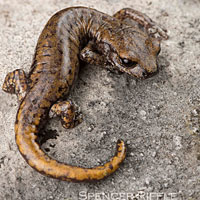
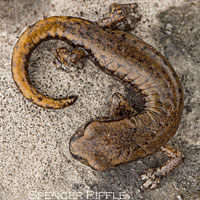
| Subadult, Shasta County © Spencer Riffle |
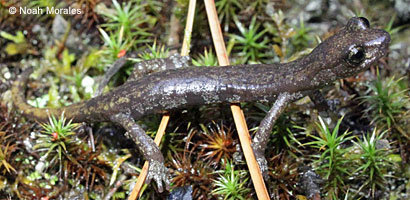
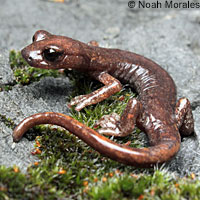
Adult, Shasta County © Noah Morales |
 |
 |
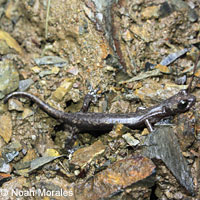 |
| Adult, Shasta County © Noah Morales |
Adult, Shasta County © Noah Morales |
Adult, Shasta County © Noah Morales |
 |
 |
 |
| Adult, Shasta County © Yuerou Tang |
Adult, Shasta County © Noah Morales |
 |
 |
|
|
| These two Shasta County adult Shasta Salamanders have little or no speckling on their upper bodies, © Noah Morales |
|
|
| |
| Juveniles |
 |
 |
|
|
| Juvenile, Shasta County © Yuerou Tang |
|
|
| |
| Habitat |
 |
 |
|
|
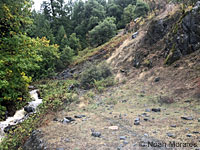
| Habitat, Shasta County © Noah Morales |
Habitat, Shasta County © Yuerou Tang |
|
|
| |
The pictures below show Hydromantes samweli - Samwel Shasta Salamander which was previously regarded as the same species as Hydromantes shastae. The two species look the same. There are no readily discernible morphological differences that can be used to differentiate them.
|
 |
 |
 |
 |
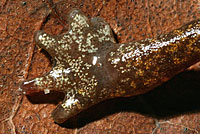
| Webbed toes make it easier for Shasta Salamanders to climb slippery vertical rocks. |
Adult, Shasta County. Notice
how flattened the body is to allow the salamander to more easily crawl into cracks. |
Adult and juvenile, Shasta County |
Adult, Shasta County |
|
|
|
|
| Description |
The following description is mostly based on the traditional descriptions of Hydromantes shastae before it was split into three species.
The three species are morphologically cryptic species, which means that you can't tell them apart by appearance in pictures or in hand.
According to the authors
who re-described H. shastae, the only difference between H. shastae and H. wintu and H. samweli is the length of the longest digits:
"The species differs from its close genetic and geographic congeners ... in allozyme and mtDNA sequence differences.... These are morphologically cryptic species, which nonetheless differ in multivariate morphometric features .... The longest digits of the pes [foot] are longer in H. shastae than in either of its morphologically cryptic relatives." **
|
| Size |
Adults measure 1 3/4 - 2 1/2 inches long (4.4 - 6.3 cm) from snout to vent length, and from 3 - 4 1/3 inches (7.5 - 11 cm) in total length.
|
| Appearance |
A small stocky salamander with a short tail, webbed feet, a flattened body, and a very long mushroom-like tongue capable of extending out up to 2.4 inches (6 cm) from the front of the mouth.
13 costal grooves, and nasolabial grooves.
Not as adapted for crack dwelling as other Hydromantes species with less toe webbing and the body is not as flattened. |
| Color and Pattern |
Dark reddish brown above, mottled with grayish green to tan specks, with some yellow on the tail.
Venter is grayish.
|
| Life History and Behavior |
A member of family Plethodontidae, the Plethodontid or Lungless Salamanders.
Plethodontid salamanders do not breathe through lungs. They conduct respiration through their skin and the tissues lining their mouth. This requires them to live in damp environments on land and to move about on the ground only during times of high humidity. (Plethodontid salamanders native to California do not inhabit streams or bodies of water but they are capable of surviving for a short time if they fall into water.)
Plethodontid salamanders are also distinguished by their nasolabial grooves, which are vertical slits between the nostrils and upper lip that are lined with glands associated with chemoreception.
All Plethodontid Salamanders native to California lay eggs in moist places on land.
The young develop in the egg and hatch directly into a tiny terrestrial salamander with the same body form as an adult.
(They do not hatch in the water and begin their lives as tiny swimming larvae breathing through gills like some other types of salamanders.)
|
| Activity |
Active at night during fall, winter, and spring rains.
They may also be active underground in the summer - over 20 were discovered in a cave in August.
Can be found under surface objects during daytime.
Adapted to climb easily over smooth rock surfaces, using webbed feet and the tail as an aid. |
| Defense |
| Defense mechanisms include raising up the head and tail and flattening the body, producing sticky toxic skin secretions, and tightly coiling the body and tail and rolling downhill (the same escape tactic used by other Hydromantes species.) (You can watch a short video of a different species of salamander using this coiling, rolling and springing escape technique here.) |
| Diet and Feeding |
| Probably feeds on insects and other small invertebrates. |
| Reproduction |
Little is known about the breeding behavior of this species.
Reproduction is terrestrial.
|
| Eggs |
Females apparently lay eggs in moist limestone shelters in late summer and brood them until they hatch in late fall.
Two clutches of 9 eggs were found in a cave by Gorman in 1956.
They would have hatched in late October or early November. |
| Young |
Young develop completely in the egg and hatch fully formed.
|
| Habitat |
Found around cliff faces, vertical cavern walls and level ground in mixed forests of Douglas fir, pines, and oaks. Lives in moist caves and rock cracks. Mostly associated with limestone outcrops, but one population has been found in a volcanic outcrop, and others in forest areas with no rock outcrops.
|
| Geographical Range |
Endemic to California in a fairly small area in the Cascade range near human-made Shasta Lake, Shasta County.
|
 |
Approximate range of Hydromantes - Web-toed Salamanders
Orange: Hydromantes shastae - Shasta Salamander
Bright Green: Hydromantes brunus - Limestone Salamander
Red: Hydromantes platycephalus - Mount Lyell Salamander
Yellow: Hydromantes samweli - Samwel Shasta Salamander
Bright Blue: Hydromantes wintu - Wintu Shasta Salamander
|
| Elevational Range |
Most locations where H. shastae have been found are at elevations between 800 - 2000 ft. (244 - 610 meters.)
In 2007 a single adult was found at 3,800 ft. (1158 meters) on Bohemotash Mountain in Shasta County.
(Len Lindstrand III. California Fish and Game 94[2):119-121. 2008)
|
| Notes on Taxonomy |
Originally discovered in the early 1900's by Eustace Farlong, but not formally described until they were re-discovered by Joseph Gorman in 1950.
(Joe Gorman and C. L. Camp. A New Cave Species of Salamander of the Genus Hydromantes from California, with Notes on Habits and Habitat. Copeia Vol. 1953, No. 1 [Feb. 26, 1953], pp. 39-43)
|
"Bingham et al. (2018, Bulletin of the Museum of Comparative Zoology 161: 403–427) provided range-wide geographic sampling for mitochondrial and nuclear data to revise the taxonomy of this complex, which had previously been estimated as inadequate by Rovito (2010, Molecular Ecology 19: 4554–4571). They also reported newly discovered populations of the H. shastae complex to the west and south which have not been studied and the taxonomic status of these populations requires further study."
(Nicholson, K. E. (ed.). 2025 SSAR Scientific and Standard English Names List) |
Hydromantes shastae is Split into Three Species in 2018
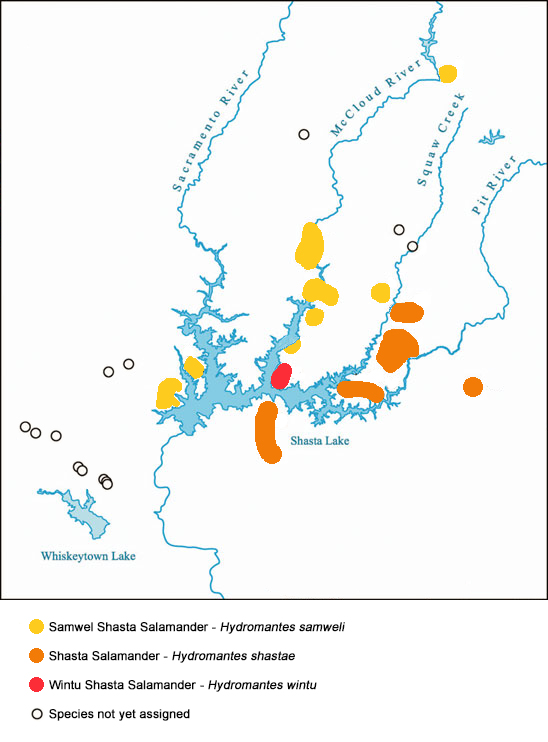
As a result of mitochondrial DNA analysis, Hydromantes shastae was split into three cryptic species* with no readily discernible morphological differences that can be used to identify them in the field. All three species occur in the same relatively small area around Shasta Lake that made up the range of Hydromantes shastae.
The three species are:
Shasta Salamander - Hydromantes shastae - Gorman and Camp, 1953
Samwel Shasta Salamander - Hydromantes samweli - Bingham, Papenfuss, Lindstrand III, and Wake, 2018
Wintu Shasta Salamander - Hydromantes wintu - Bingham, Papenfuss, Lindstrand III, and Wake, 2018
* Robert E. Bingham, Theodore J. Papenfuss, Len Lindstrand III, and David B. Wake.
Phylogeography and Species Boundaries in the Hydromantes shastae Complex, with Description of Two New Species (Amphibia; Caudata; Plethodontidae)
Bulletin of the Museum of Comparative Zoology
Volume 161, Number 10, 4 April 2018
|
 |
H. shastae is one of five species of Hydromantes, all of which are endemic to California, including the two other Shasta complex Hydromantes and H. brunus, and
H. platycephalus.
Eight species of similar salamanders once placed in the genus Hydromantes but now placed in the genus Speleomantes occur in Italy and southern France and on the island of Sardinia. They are the only plethodontid salamanders found outside of the Americas. (A new species of lungless salamander found in Asia in 2004 was placed in a new genus.) Why Hydromantes/Speleomantes are found only in Europe and California is still a biogeographical mystery.
-----------------------------------------------------------------------------------------------------------------------------------------------------------------------------------------------------------------------------
In Detecting Cryptic Species Using Allozyme Data, (Bruce, Jaeger and Houck (editors) The Biology of Plethodontid Salamanders, 2000.) Richard Highton suggests that Hydromantes shastae consists of two species. He describes a 1978 allozyme analysis by Wake et al of 5 samples from near Lake Shasta that showed one sample from near Potter and Marble Creeks diverging from the other four, and recognized that it might represent a separate species, though he did not recommend any taxonomic changes. The four other samples are closer genetically to H. platycephalus than they are to the Potter-Marble Creek form.
-----------------------------------------------------------------------------------------------------------------------------------------------------------------------------------------------------------------------------
"This species shows great genetic substructuring, especially unusual given its small geographic range (Wake et al., 1978). The genetic data were analyzed by Larson et al. (1984), who found that the species conforms to a genetic structure and pattern of gene flow in accordance with an island model ... which means that effectively no species-wide gene flow is taking place now or in the recent past." (David Wake and Theodore Papenfuss in Lanoo 2005)
|
Alternate and Previous Names (Synonyms)
Hydromantes shastae - Shasta Salamander (Stebbins 1954, 1966, 1985, 2003, 2012)
|
| Conservation Issues (Conservation Status) |
Listed as a threatened species by the state of California under the name Hydromantes shastae.
The limited habitat of this species is threatened by increased recreation around Shasta Lake, limestone quarrying, and raising of lake water levels. Much of its habitat was probably lost in the construction of Shasta Dam in 1949, and from road building and mining.
Raising the height of the Shasta Dam could increase the size of Lake Shasta to the point that it would flood and destroy this salamander's habitat, putting it at risk of extinction. For decades, organizations wanting to provide more water to Central Valley farmers have tried to raise the height of the dam. In 1972, California passed the Wild and Scenic Rivers Act which prohibits making the dam any taller, but the federal government under the Trump administration has chosen to ignore the law and proceed with a plan to make the dam higher.
Before it was split into three species in 2018, environmental organizations petitioned the U.S. Fish and Wildlife Service in 2012 to determine if the Shasta Salamander should be given protection under the Endangered Species Act. The federal agency was required by law to make a decision in one year, but failed to do so in six years. In 2018, the U.S. Fish and Wildlife Service sued to force a decision after the federal government proceeded with plans to increase the height of the dam. If the salamander is given endangered species protection, that could stop construction on the dam.
The outcomes of the lawsuit and of the dam construction project remain to be seen at the end of 2018. L. A. Times Article 12/26/18 |
|
| Taxonomy |
| Family |
Plethodontidae |
Lungless Salamanders |
Gray, 1850 |
| Genus |
Hydromantes |
Web-toed Salamanders |
Gistel, 1848 |
Species
|
shastae |
Shasta Salamander |
Gorman and Camp, 1953 |
|
Original Description |
First described as Hydromantes shastae by Gorman and Camp, 1953 - Copeia, p. 39
from Original Description Citations for the Reptiles and Amphibians of North America © Ellin Beltz
|
|
Meaning of the Scientific Name |
Hydromantes - Greek - hydro = water + mantis = soothsayer or prophet
shastae - Shasta County, California, the type locality
from Scientific and Common Names of the Reptiles and Amphibians of North America - Explained © Ellin Beltz
|
|
Related California Salamanders |
Mt. Lyell Salamander
Limestone Salamander
Samwel Shasta Salamander
Wintu Shasta Salamander
|
|
More Information and References |
California Department of Fish and Wildlife
AmphibiaWeb
** Robert E. Bingham, Theodore J. Papenfuss, Len Lindstrand III, and David B. Wake.
Phylogeography and Species Boundaries in the Hydromantes shastae Complex, with Description of Two New Species (Amphibia; Caudata; Plethodontidae)
Bulletin of the Museum of Comparative Zoology Volume 161, Number 10, 4 April 2018
Hansen, Robert W. and Shedd, Jackson D. California Amphibians and Reptiles. (Princeton Field Guides.) Princeton University Press, 2025.
Stebbins, Robert C., and McGinnis, Samuel M. Field Guide to Amphibians and Reptiles of California: Revised Edition (California Natural History Guides) University of California Press, 2012.
Stebbins, Robert C. California Amphibians and Reptiles. The University of California Press, 1972.
Flaxington, William C. Amphibians and Reptiles of California: Field Observations, Distribution, and Natural History. Fieldnotes Press, Anaheim, California, 2021.
Nicholson, K. E. (ed.). 2025. Scientific and Standard English Names of Amphibians and Reptiles of North America North of Mexico, with Comments Regarding Confidence in Our Understanding. Ninth Edition. Society for the Study of Amphibians and Reptiles. [SSAR] 87pp.
Gorman, J. and Camp, C. L. (1953). "A new cave species of salamander of the genus Hydromantes from California, with notes on habits and habitats." Copeia, 1953, 39-43.
Thelander, Carl G., editor in chief. Life on the Edge - A Guide to California's Endangered Natural Resources - Wildlife. Berkeley: Bio Systems Books, 1994.
Samuel M. McGinnis and Robert C. Stebbins. Peterson Field Guide to Western Reptiles & Amphibians. 4th Edition. Houghton Mifflin Harcourt Publishing Company, 2018.
Stebbins, Robert C. A Field Guide to Western Reptiles and Amphibians. 3rd Edition. Houghton Mifflin Company, 2003.
Behler, John L., and F. Wayne King. The Audubon Society Field Guide to North American Reptiles and Amphibians. Alfred A. Knopf, 1992.
Robert Powell, Roger Conant, and Joseph T. Collins. Peterson Field Guide to Reptiles and Amphibians of Eastern and Central North America. Fourth Edition. Houghton Mifflin Harcourt, 2016.
Powell, Robert., Joseph T. Collins, and Errol D. Hooper Jr. A Key to Amphibians and Reptiles of the Continental United States and Canada. The University Press of Kansas, 1998.
American Museum of Natural History - Amphibian Species of the World 6.2
Bartlett, R. D. & Patricia P. Bartlett. Guide and Reference to the Amphibians of Western North America (North of Mexico) and Hawaii. University Press of Florida, 2009.
Bishop, Sherman C. Handbook of Salamanders. Cornell University Press, 1943.
Lannoo, Michael (Editor). Amphibian Declines: The Conservation Status of United States Species. University of California Press, June 2005.
Petranka, James W. Salamanders of the United States and Canada. Smithsonian Institution, 1998.
Jones, Lawrence L. C. , William P. Leonard, Deanna H. Olson, editors. Amphibians of the Pacific Northwest. Seattle Audubon Society, 2005.
|
|
|
The following conservation status listings for this animal are taken from the July 2025 State of California Special Animals List and the July 2025 Federally Listed Endangered and Threatened Animals of California list (unless indicated otherwise below.) Both lists are produced by multiple agencies every year, and sometimes more than once per year, so the conservation status listing information found below might not be from the most recent lists, but they don't change a great deal from year to year.. To make sure you are seeing the most recent listings, go to this California Department of Fish and Wildlife web page where you can search for and download both lists:
https://www.wildlife.ca.gov/Data/CNDDB/Plants-and-Animals.
A detailed explanation of the meaning of the status listing symbols can be found at the beginning of the two lists. For quick reference, I have included them on my Special Status Information page.
If no status is listed here, the animal is not included on either list. This most likely indicates that there are no serious conservation concerns for the animal. To find out more about an animal's status you can also go to the NatureServe and IUCN websites to check their rankings.
Check the current California Department of Fish and Wildlife sport fishing regulations to find out if this animal can be legally pursued and handled or collected with possession of a current fishing license. You can also look at the summary of the sport fishing regulations as they apply only to reptiles and amphibians that has been made for this website.
Some researchers, including this website, now recognize the species Hydromantes shastae as consisting of three separate species.
The status listings below are based on all three of these species combined as one species, as it was for many years: Hydromantes shastae.
Notes from the CNDBB State and Federally Listed Endangered and Threatened Animals of California List, July 2023:
"Hydromantes shastae has been proposed to consist of cryptic genetic structuring that may warrant recognition of additional species named as Hydromantes samweli and Hydromantes wintu (Bingham et al. 2018, Bull. Mus. Comp. Zool. 161(10):403- 427). Until formally reviewed by the Fish and Game Commission, all populations in the Shasta salamander complex are legally state threatened.
|
| Organization |
Status Listing |
Notes |
| NatureServe Global Ranking |
G3 |
Vulnerable |
| NatureServe State Ranking |
S3 |
Vulnerable
|
| U.S. Endangered Species Act (ESA) |
None |
|
| California Endangered Species Act (CESA) |
ST |
Listed as Threatened 6/27/1971 |
| California Department of Fish and Wildlife |
None |
|
| Bureau of Land Management |
S |
Sensitive |
| USDA Forest Service |
S |
Sensitive |
| IUCN |
VU |
Vulnerable |
|
|
|