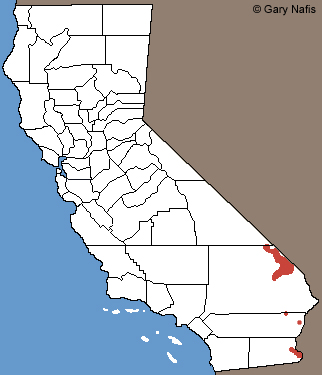
Range in California: Red
Click on the map for a topographical view
Map with California County Names
Click here to see a zoomable Google Map of Heloderma sighting locations in California (based on Lovich and Beaman, 2007 3)
|
Venomous and Potentially Dangerous!
 |
 |
 |
 |
Adult, Providence Mountains,
San Bernardino County,
photographed 5/2/2009
© Dave Bowlus
|
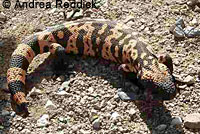
Adult, Providence Mountains, San Bernardino County,
photographed 5/2/2009 © Andrea Reddick |
Adult, Providence Mountains,
San Bernardino County
found 4/16/1968
© Harold De Lisle |
 |
|
|
|
Adult, Piute Mountains,
San Bernardino County,
found 5/9/1982
© Earl Curran
Contributed by Harold De Lisle |
|
|
|
| |
|
|
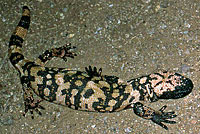
| Banded Gila Monsters From Outside California |
 |
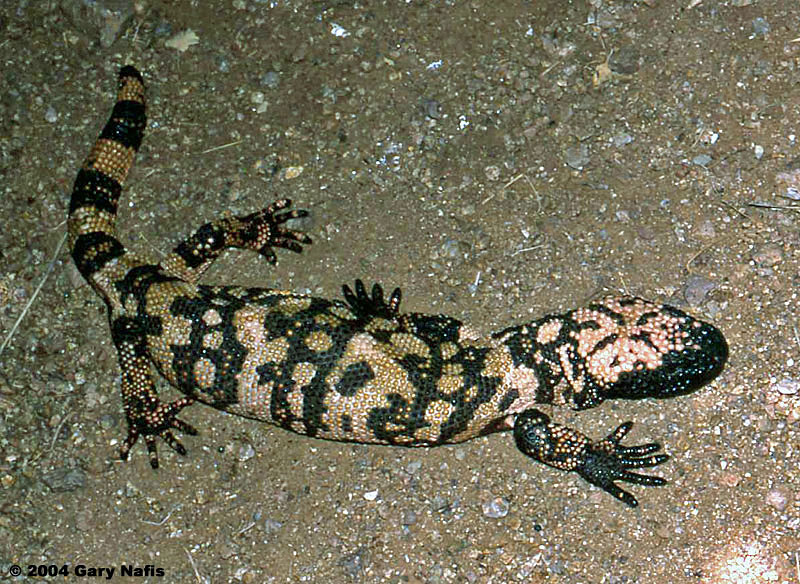
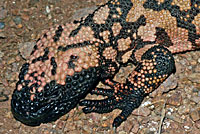
| Adult, Arizona. © Gary Nafis. Specimen courtesy of Randy Babb |
 |
 |
 |
 |
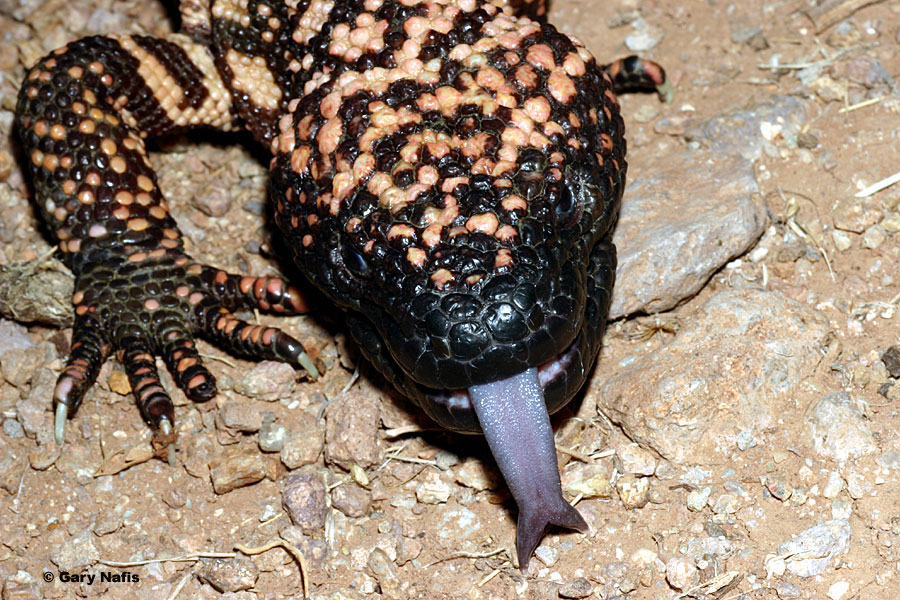
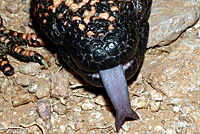
| Adult, Arizona. © Gary Nafis. Specimen courtesy of Randy Babb |
 |
 |
 |
 |
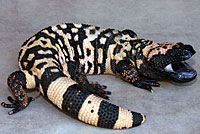
| Adult, Arizona. © Gary Nafis. Specimen courtesy of Randy Babb |
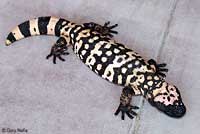
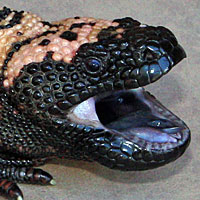
Adult, Arizona. © Gary Nafis. Specimen courtesy of Arizona-Sonora Desert Museum |
 |
 |
 |
 |
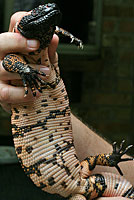
| Adult, Arizona. © Gary Nafis. Specimen courtesy of Arizona-Sonora Desert Museum |
Captive-bred Adult, Austin Texas |
 |
 |
 |
 |
| Captive-bred Adult |
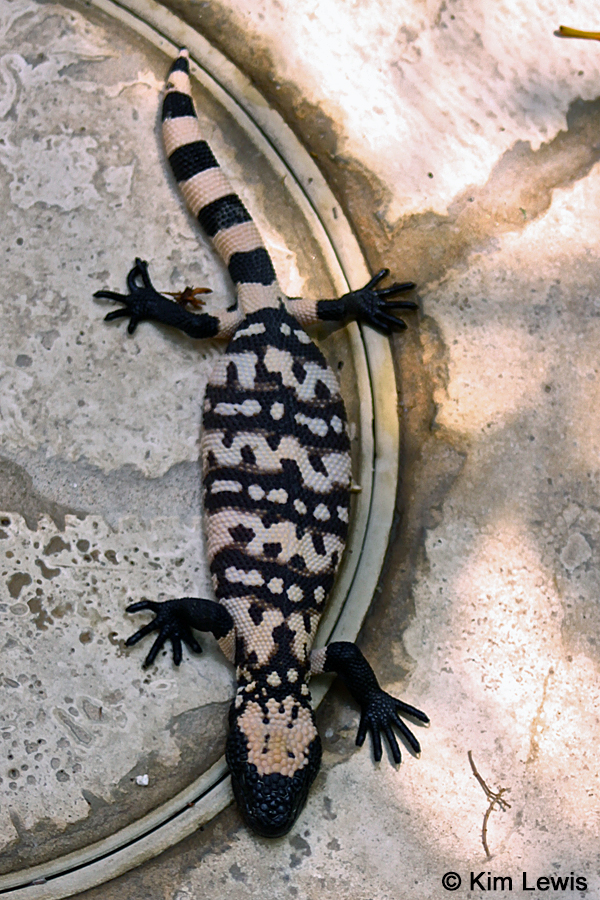
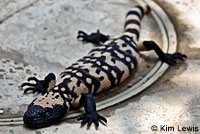
Juvenile (maybe a hatchling) found in early June next to a swimming pool at Red Rock in Clark County Nevada.
© Kim Lewis |
 |
|
|
|
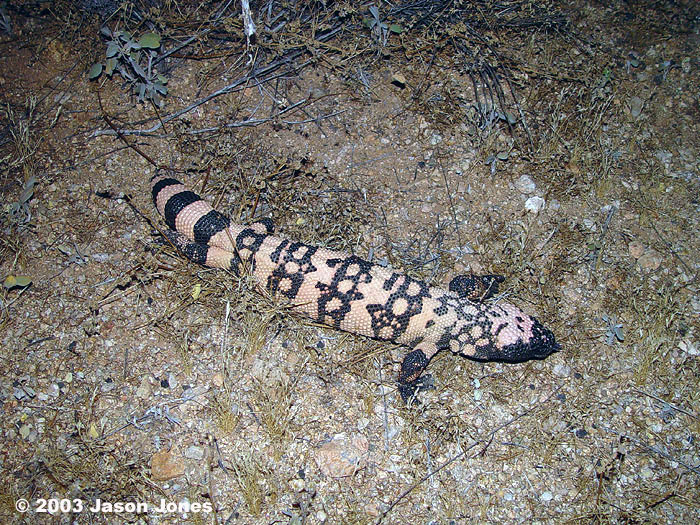
Adult, Yavapai county Arizona. This protected lizard is on the side of a busy road where herpers are known to go hunt for reptiles at night. It has been placed there by Arizona law enforcement officers in order to attract and arrest Gila Monster poachers or anybody who might stop to pick up the lizard to take photographs of it. © Jason Jones
|
|
|
|
| |
|
|
|
| |
 |
 |
|
|
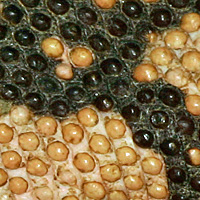
Gila Monsters have round scales on the back that look like small beads.
|
Top: side view of the head showing the position of the poison gland on the lower jaw, and below,
Bottom:
the lower jaw bones, showing the grooved teeth used to distribute the venom.
From "The reptiles of western North America v.I (1922) by Biodiversity Heritage Library contributed by Smithsonian Libraries. |
|
|
| |
|
|
|
| Habitat |
 |
 |
 |
|
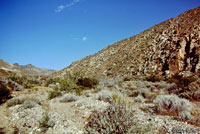
| Habitat, wash at 4,000 ft. Providence Mountains, San Bernardino County |
Eastern Providence Mountains,
San Bernardino County |
Granite Mountains in the distance,
San Bernardino County
|
|
 |
 |
|
|
| Providence Mountains in the distance, San Bernardino County |
Granite Mountains in the distance,
San Bernardino County |
|
|
| |
|
|
|
| Short Video and Sound
|
 |
 |
|
|
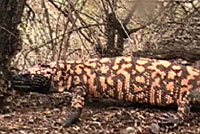
| This is a short video of the other subspecies of Gila Monster, H. s. suspectum, crawling around in the Chiricahua Mountains of Arizona. |
A Reticulate Gila Monster, H. s. suspectum, in Pima County, Arizona, wiggles its tail in an apparent "tail decoy" movement. © Steve Bledsoe |
|
|

|
|
|
|
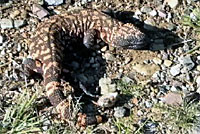
Recording of the hissing exhalations of a disturbed Gila Monster.
© Jeff Rice / Western Soundscape Archive
Not to be used without permission.
Captive specimen courtesy of
Frank Lundburg. |
Recording of the hissing of an upset captive adult (shown above) courtesy of the Arizona-Sonora Desert Museum.
© Jeff Rice / Western Soundscape Archive Not to be used without permission. |
|
|
|
|
|
|
| Description |
Dangerously Venomous
Gila Monster venom is potentially dangerous to humans, though it is not known to be fatal.
A
bite from this lizard can cause serious illness or injury in humans that may require immediate medical care.
It is the only venomous lizard native to the United States.
Commonly called "poisonous" to indicate that its bite is dangerous, but that is not correct. It should be called "venomous."
(A poisonous animal can harm you if you eat it. A venomous animal can harm you if it bites you.)
|
| Size |
9 - 14 inches long from snout to vent (22.8- 35.5 cm.)
The largest native lizard in California and the United States.
|
| Appearance |
A large lizard with a stout body, large head, thick limbs and a short fat tail.
There are loose folds of skin on the neck and a gular fold.
The dorsal surfaces of the skin are covered with hard round bead-like scales.
The ventral scales are flat and squarish.
The tongue is dark and forked like that of a snake. |
| Color and Pattern |
The color is orange or pink with 4 irregular dark bands or saddles across the back with little mottling between them.
The tail is striped with 5 dark bands.
The sides and snout of the head are black.
|
| Life History and Behavior |
Activity |
Active day or night.
Probably diurnal after emergence becoming nocturnal as temperatures increase.
Often seen at dusk or after dark following summer rains.
Terrestrial, but occasionally seen climbing brush.
Slow moving.
Spends most of its life underground (over 96% of their time 2), taking shelter in mammal burrows, under rocks, in crevices, packrat nests, thickets and other natural cavities.
May be active on the surface for a total of only 3 or 4 weeks per year, much of it probably in April and May. |
| Defense |
| Not very defensive unless harassed. |
| Diet and Feeding |
Eats small mammals, reptiles and their eggs, insects, bird eggs and nestlings, especially those of ground-nesters such as quail and doves. Can probably survive on only 3 - 4 meals per year, storing extra fat in the tail for later use.
Kills prey primarily by crushing it with powerful jaws, but also injects toxic venom.
|
| Venom |
The Gila Monster is one of a small number of venomous lizards (which include the Mexican Beaded Lizard, the Komodo Dragon, and some Australian lizards.)
Gila Monster venom is very toxic but a relatively small amount is introduced by its bite so it has not been known to be fatal to humans. Enlarged grooved teeth in the lower jaw combined with a powerful bite and chewing action introduce the venom into the prey. A Gila monster typically needs to hold onto its prey for more than ten minutes to envenomate it.
|
| Reproduction |
Mating occurs in spring and early summer. Males fight each other for access to females.
Females lay eggs usually every other year from July to August.
Hatchlings have been observed in the spring, suggesting that the eggs overwinter after incubating for 8 - 10 months.
|
| Habitat |
Prefers rocky areas in desert scrub and semi-desert grassland. Found in lower mountain slopes, rocky bajadas, canyon bottoms, and arroyos. Occasionally found in woodland in Arizona.
According to Jeffrey E. Lovich and Kent R. Beaman3 " Habitat in which the species has been observed in California is characterized by rocky, deeply incised topography, in most cases, associated with large and relatively high mountain ranges. Most localities are associated with riparian areas (including the lower Colorado River) and range from near sea level to over 1,200 m. All records except one (Mojave River) occur east of about 1160 longitude....Summer precipitation may be important in the foraging ecology of the species."
|
| Geographical Range |
The species Heloderma suspectum ranges from the far southwest corner of Utah through extreme southern Nevada into extreme eastern Riverside and San Bernardino Counties in California, south through Arizona into extreme southwestern New Mexico and south into Sonora and possibly Nayarit, Mexico.
California Sightings
According to Robert Stebbins1 this lizard occurs in the "Paiute, Clark, Kingston, and perhaps New York Mts. (sight record), San Bernardino Co." and there are "old records for Providence Mts., San Bernardino Co., vicinity of Desert Center, in Chuckwalla Mts., Riverside Co., and Imperial Dam area, Imperial Co. on the Colorado R."
In 2007, Jeffrey E. Lovich and Kent R. Beaman3 wrote "The distribution of the species in California suggests an invasion into the high mountain ranges of the northeastern Mojave during the last interglacial via the Colorado River corridor."
Lovich and Beaman
state that there are as many as 26 credible records that have been documented from four California counties; Inyo, San Bernardino, Riverside, and Imperial, including sightings from the Kingston Range, Clark Mountain, the Providence Mountains, near Blythe, Imperial Dam, Cadiz Valley near Iron Mountain, Chuckwalla Valley (Granite Mountains), Piute Creek (Piute Mountains), and the Mojave River.
Since that 2007 paper was published, another sighting has been documented (Ruppert. Herpetological Review 41(1), 2010 p. 107) (3 pictures shown above) A group of Cuesta College faculty and students on a trip to the Mojave National Preserve spotted one on a gravel road in the Providence Mountains at 4:20 PM on May 2nd, 2009. Air temperature was 76 degrees. More information about the Providence Mountains Gila Monster.
The Ophidiophilia blog has a description of the event and a picture of the lizard.
On May 7, 2015, another Gila Monster was found in the Mesquite Mountains, filling in a gap in the distribution in that area.
(Beaman, Scurlock, Lovich, Kobelt. Herpetological Review 46(3), 2015)
On May 7, 2017, I received a report of a Gila Monster observed in the Sand Flat basin in the Cottonwood Mountains of Death Valley National Park at about 4,400 ft. If this location is verified it would extend the range about a hundred miles to the north.
|
| I have made a zoomable Google Map approximating the records for Heloderma in California that I have found. Most pin locations are only approximate. Click the map below to go to the Google Maps page. |

|
 |
Approximate distribution of Heloderma suspectum - Gila Monster
Orange: Heloderma suspectum cinctum - Banded Gila Monster
-Not found in California
Red: Heloderma suspectum suspectum - Reticulate Gila Monster
|
| Elevational Range |
From near sea level to over 3,940 ft., (1,200 m.)
|
| Notes on Taxonomy |
Two subspecies of Heloderma suspectum are traditionally recognized. Heloderma suspectum suspectum, the Reticulate Gila Monster, occurs south and east of the range of H. s. cinctum.
------------------------------------------------------------------------------------------------------------------------------------------------------------------------------------------------------------------------------
A 2010 study (Douglas et al. Molecular Phylogenetics. Evol. 55: 153-167) found no mtDNA evidence for the recognition of two subspecies of Heloderma suspectum. Following that, this taxon becomes Heloderma suspectum - Gila Monster.
------------------------------------------------------------------------------------------------------------------------------------------------------------------------------------------------------------------------------
Hansen and Shedd (2025) follow Douglas et al. (2010) and do not recognize any subpecies of H. suspectum.
------------------------------------------------------------------------------------------------------------------------------------------------------------------------------------------------------------------------------
"Douglas et al. (2010, Molecular Phylogenetics and Evolution 55: 153–167) stated that they found no mtDNA evidence to support the two subspecies of H. suspectum. Although they did not provide information on the collection localities of the sampled specimens needed to evaluate that conclusion, that information was provided subsequently by Schuett and Reiserer (2017, Herpetological Review 48: 798–801)."
(Nicholson, K. E. (ed.). 2025 SSAR Scientific and Standard English Names List)
------------------------------------------------------------------------------------------------------------------------------------------------------------------------------------------------------------------------------
Alternate and Previous Names (Synonyms)
Heloderma suspectum - Gila Monster - (Nicholson, K. E. (ed.). 2025 SSAR Scientific and Standard English Names List)
Heloderma suspectum - Gila Monster - (Hansen and Shedd 2025)
Heloderma suspectum - Arizona Gila Monster (Smith 1946)
|
| Conservation Issues (Conservation Status) |
It is unlawful to import, transport, or possess the Reticulate Gila Monster - Heloderma suspectum suspectum subspecies in California except under permit issued by the California Department of Fish and Wildlife.
(California Code of Regulations, Title 14, Excerpts, Section 671)
------------------------------------------------------------------------------------------------------------------------------------------------------------------------------------------------------------------------------
"Conservation of the Gila monster in California requires an understanding of the factors defining its rarity along with the interaction of historical and climatic factors. It is likely that the Gila monster was rare in California long before the arrival of Europeans due to climatic changes and the marginal location of the state in the range of this species. The current restriction of the range to areas east of 1160 longitude provides a focal area for conservation efforts. Fortunately, this part of California, often referred to as the "Lonesome Triangle," is stil largely undisturbed (but see Lovich and Bainbridge 1999 4), and much of the Gila monster habitat therein is protected in designated wilderness areas or the Mojave National Preserve. However, the small population size of Gila monsters in California presents special challenges, including the Allee effect, loss of genetic diversity, and inbreeding (Meyers 1997), that are not easy to manage and increase the risk of local or regional extirpation. Recognition of these challenges will be required to maintain the elusive and enigmatic Gila monster as a viable part of California's exceptionally diverse biota (Meyers et al.. 2000 5)." Lovich and Beaman, 2007 3
4 Lovich J. E., Bainbridge D. 1999. Anthropogenic degradation of the southern California desert ecosystem
and prospects for natural recovery and restoration. Environ. Mgmt. 24: 309-326.
5 Meyers N., Mittermeier RA, Mittermeier C.G., Fonseca GAB., Kent J. 2000. Biodiversity hotspots for
conservation priorities. Nature. 403: 853-845.
------------------------------------------------------------------------------------------------------------------------------------------------------------------------------------------------------------------------------
There is a description and conservation status summary of this taxon with a dot-locality distribution map in an online .pdf from the California Department of Fish and Wildlife book California Amphibian and Reptile Species of Special Concern (Thomson, Wright, and Shaffer 2016).
The book describes the threats to this species:
"The principal threats facing Heloderma suspectum in California are its small and extremely
patchy distribution, coupled with the probable marginal habitat found in the state and presumed sensitivity to the effects of climate change. Further, we know virtually nothing about the ecology or population status of this species in California, so declines may occur that go undetected."
|
|
|
Taxonomy |
| Family |
Helodermatidae |
Venomous Lizards |
Gray, 1837 |
| Genus |
Heloderma |
Gila Monsters and Beaded Lizards |
Wiegmann, 1829 |
| Species |
suspectum |
Gila Monster |
Cope, 1869 |
Subspecies
|
cinctum
|
Banded Gila Monster |
Bogert and Martín del Campo, 1956 |
|
Original Description |
Heloderma suspectum - Cope, 1869 - Proc. Acad. Nat. Sci. Philadelphia, Vol. 21, p. 5
Heloderma suspectum cinctum - Bogert and Martin del Campo, 1956 - Amer. Mus. Nat. Hist. Bull., Vol. 109, Art. 1, p. 46
from Original Description Citations for the Reptiles and Amphibians of North America © Ellin Beltz
|
|
Meaning of the Scientific Name |
Heloderma - Greek - helos = a nail or stud + derma = skin - refers to the rough texture of the skin of this genus
suspectum - Latin = mistrusted or suspected - refers to a venomous nature which was suspected but not proven at time of naming.
cinctum - Latin = belted - referring to the broad double cross-bands.
from Scientific and Common Names of the Reptiles and Amphibians of North America - Explained © Ellin Beltz
|
|
Related or Similar California Lizards |
None, although sometimes Banded Geckos and juvenile Chuckwallas may be mistaken for Gila Monsters.
|
|
More Information and References |
California Department of Fish and Wildlife
There is a description and conservation status summary of this taxon with a dot-locality distribution map in an online .pdf from the California Department of Fish and Wildlife book California Amphibian and Reptile Species of Special Concern (Thomson, Wright, and Shaffer 2016).
Reptiles and Amphibians of Arizona
Dr. Seward's Gila Monster Site
Hansen, Robert W. and Shedd, Jackson D. California Amphibians and Reptiles. (Princeton Field Guides.) Princeton University Press, 2025.
Stebbins, Robert C., and McGinnis, Samuel M. Field Guide to Amphibians and Reptiles of California: Revised Edition (California Natural History Guides) University of California Press, 2012.
Stebbins, Robert C. California Amphibians and Reptiles. The University of California Press, 1972.
Flaxington, William C. Amphibians and Reptiles of California: Field Observations, Distribution, and Natural History. Fieldnotes Press, Anaheim, California, 2021.
Nicholson, K. E. (ed.). 2025. Scientific and Standard English Names of Amphibians and Reptiles of North America North of Mexico, with Comments Regarding Confidence in Our Understanding. Ninth Edition. Society for the Study of Amphibians and Reptiles. [SSAR] 87pp.
1Samuel M. McGinnis and Robert C. Stebbins. Peterson Field Guide to Western Reptiles & Amphibians. 4th Edition. Houghton Mifflin Harcourt Publishing Company, 2018.
Stebbins, Robert C. A Field Guide to Western Reptiles and Amphibians. 3rd Edition. Houghton Mifflin Company, 2003.
Behler, John L., and F. Wayne King. The Audubon Society Field Guide to North American Reptiles and Amphibians. Alfred A. Knopf, 1992.
Robert Powell, Roger Conant, and Joseph T. Collins. Peterson Field Guide to Reptiles and Amphibians of Eastern and Central North America. Fourth Edition. Houghton Mifflin Harcourt, 2016.
Powell, Robert., Joseph T. Collins, and Errol D. Hooper Jr. A Key to Amphibians and Reptiles of the Continental United States and Canada. The University Press of Kansas, 1998.
Brennan, Thomas C., and Andrew T. Holycross. Amphibians and Reptiles in Arizona. Arizona Game and Fish Department, 2006.
Bartlett, R. D. & Patricia P. Bartlett. Guide and Reference to the Turtles and Lizards of Western North America (North of Mexico) and Hawaii. University Press of Florida, 2009.
Jones, Lawrence, Rob Lovich, editors. Lizards of the American Southwest: A Photographic Field Guide. Rio Nuevo Publishers, 2009.
Smith, Hobart M. Handbook of Lizards, Lizards of the United States and of Canada. Cornell University Press, 1946.
Taylor, Emily. California Lizards and How to Find Them. Heyday, Berkeley, California. 2025.
Brown, David E., Neil B. Carmony. Gila Monster: Facts and Folklore of America's Aztec Lizard. High-Lonesome Books, 1991.
2 Degenhardt, William G., Charles W. Painter, & Andrew H. Price. Amphibians and Reptiles of New Mexico. University of New Mexico Press, 1996.
3 Jeffrey E. Lovich, Kent R. Beaman. Volume 106. Issue 2 (August 2007) Bulletin, Southern California Academy of Sciences Article: pp. 39-58 I Abstract I PDF (3.15M) A History of Gila Monster (Heloderma suspectum cinctum) Records from California with Comments on Factors Affecting their Distribution.
|
|
|
The following conservation status listings for this animal are taken from the July 2025 State of California Special Animals List and the July 2025 Federally Listed Endangered and Threatened Animals of California list (unless indicated otherwise below.) Both lists are produced by multiple agencies every year, and sometimes more than once per year, so the conservation status listing information found below might not be from the most recent lists, but they don't change a great deal from year to year.. To make sure you are seeing the most recent listings, go to this California Department of Fish and Wildlife web page where you can search for and download both lists:
https://www.wildlife.ca.gov/Data/CNDDB/Plants-and-Animals.
A detailed explanation of the meaning of the status listing symbols can be found at the beginning of the two lists. For quick reference, I have included them on my Special Status Information page.
If no status is listed here, the animal is not included on either list. This most likely indicates that there are no serious conservation concerns for the animal. To find out more about an animal's status you can also go to the NatureServe and IUCN websites to check their rankings.
Check the current California Department of Fish and Wildlife sport fishing regulations to find out if this animal can be legally pursued and handled or collected with possession of a current fishing license. You can also look at the summary of the sport fishing regulations as they apply only to reptiles and amphibians that has been made for this website.
Special Animals List refers to the subspecies Heloderma suspectum cinctum - Banded Gila Monster, with the following note:
The BLM "Sensitive Species" designation refers to the full species.
|
| Organization |
Status Listing |
Notes |
| NatureServe Global Ranking |
G4T3 |
The species and subspecies are: Apparently Secure—Uncommon but not rare; some cause for long-term concern due to declines or other factors. |
| NatureServe State Ranking |
S1 |
Critically Imperiled |
| U.S. Endangered Species Act (ESA) |
None |
|
| California Endangered Species Act (CESA) |
None |
|
| California Department of Fish and Wildlife |
SSC |
Species of Special Concern |
| Bureau of Land Management |
S |
Sensitive |
| USDA Forest Service |
None |
|
| IUCN |
None |
|
|
|