|
 |
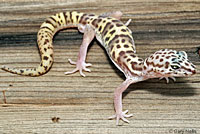
| Adult, eastern Riverside County desert |
 |
 |
 |
 |
| |
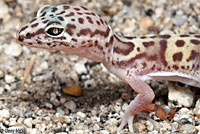
Adult, eastern Riverside County desert |
|
 |
 |
 |
 |
| Adult, Inyo County desert |
Adult, San Diego County desert |
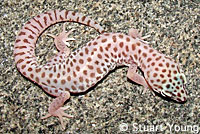
Spotted adult - with no bands,
Imperial County. © Stuart Young
|
 |
 |
 |
 |
| Adult, Inyo County |
Adult female, Imperial County |
Adult, San Diego County |
 |
 |
 |
 |
| Adult male, Imperial County |
Adult, Imperial County |
Adult, Imperial County |
 |
 |
 |
 |
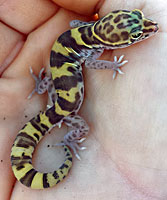
Adult from near Canyon Country,
Los Angeles County © Anonymous |
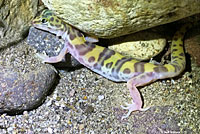
Adult, Santa Clarita,
Los Angeles County © Jeff Ahrens |
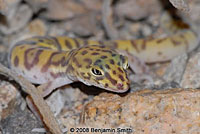
Adult, San Bernardino County desert
© Ben Smith |
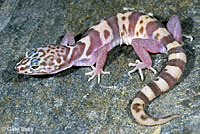
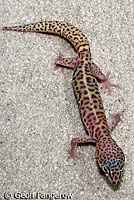
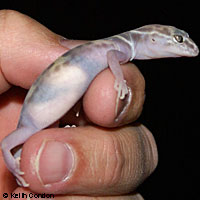
Adult, eastern Riverside County desert
© Geoff Fangerow |
 |
 |
 |
 |
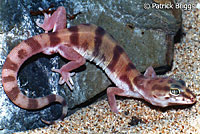
Adult, San Diego County desert
© Patrick Briggs |
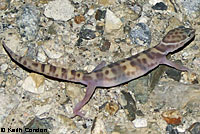
Gravid adult female, Mono County © Keith Condon |
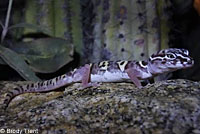
Adult, Riverside County
© Brody Trent |
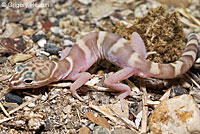 |
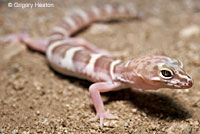 |
 |
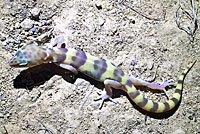 |
Adult, Inyo County
© Grigory Heaton |
Adult, Riverside County
© Grigory Heaton |
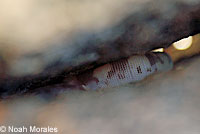
Banded geckos are not known for climbing as well as other kinds of geckos, such as the Hemidactylus, but it is not uncommon to find them sheltering in cracks or under caps on large boulders that they have climbed. This adult male (notice the spur at the base of his tail) is hiding in an elevated rock crack in the Eastern Sierra Nevada Mountains in Inyo County
© Noah Morales. |
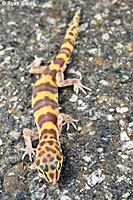
This adult was reportedly found west of the known range of the species in the hills between Simi Valley and Hwy 101 near Thousand Oaks in Ventura County in June 2016. Locations this specific are not typically mentioned here, but I'm hoping that someone will be inspired to search the area to confirm that banded geckos are there then let me know. |
 |
 |
 |
 |
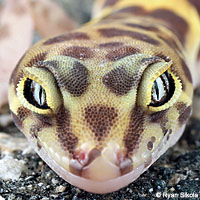
| Adult, Los Angeles County Mountains © Ryan Sikola |
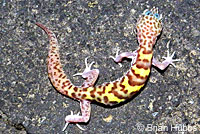
This bright yellow adult was found in Imperial County at the Colorado River near Yuma. © Brian Hubbs |
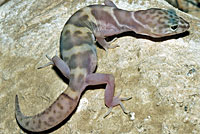
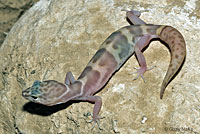
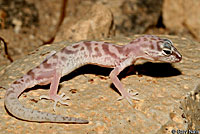
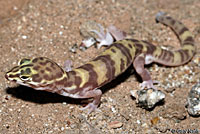
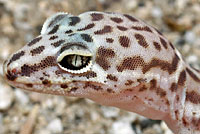
These adult geckos illustrate how variable the colors and patterns of this species can be. © Stuart Young |
 |
 |
|
|
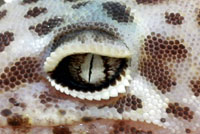
Adult, eastern Riverside County desert.
Note that Desert Banded Geckos have moveable eyelids and vertical pupils. |
|
|
| |
|
|
|
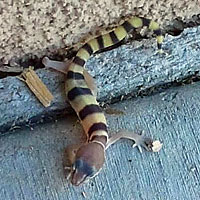
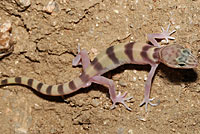
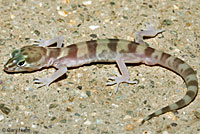
Juveniles |
 |
 |
 |
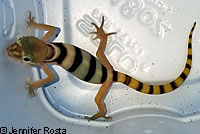 |
Juvenile, Santa Clarita,
Los Angeles County |
Juvenile, eastern Kern County |
Juvenile, Imperial County |
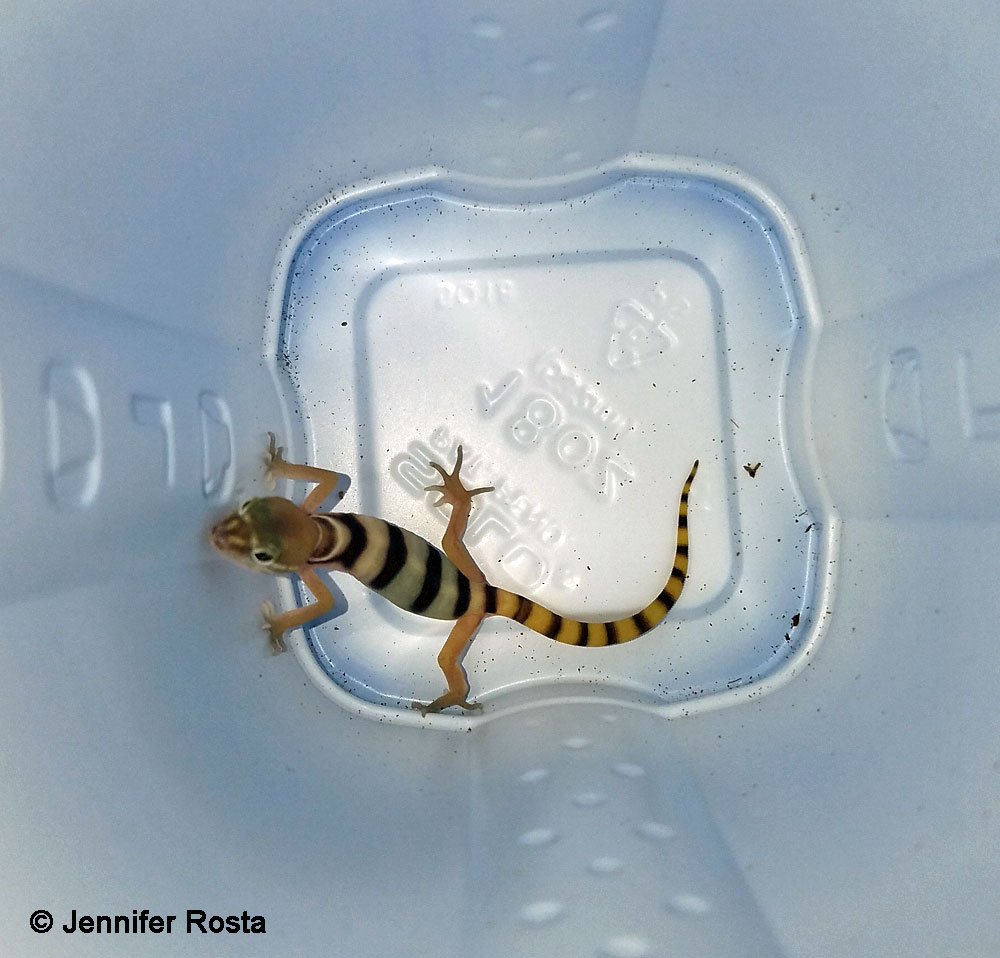
Juvenile, San Bernardino County
© Jennifer Rosta |
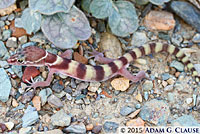 |
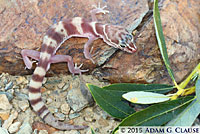 |
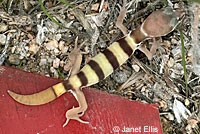 |
 |
Juvenile male, Mono County
© Adam G. Clause
|
Subadult male, Mono County
© Adam G. Clause |
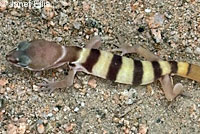
Juvenile, L.A. County desert © Janet Ellis |
| |
|
|
|
Comparisons of Banded Geckos in California
Also see Banded Geckos in California - Genus Coleonyx
|
 |
 |
 |
|
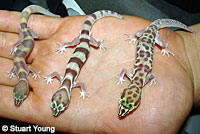
Left: San Diego Banded Gecko
Middle: Intergrade
Right: Desert Banded Gecko
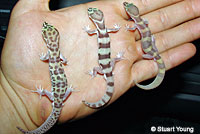
All three were found in Baja California where the ranges of the two subspecies meet. © Stuart Young |
Right: San Diego Banded Gecko
Middle: Intergrade
Left: Desert Banded Gecko
All three were found in Baja California where the ranges of the two subspecies meet. © Stuart Young
|
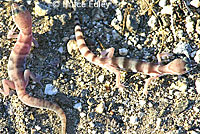
Desert Banded Gecko - left
San Diego Banded Gecko - right
© Bruce Edley |
|
| |
|
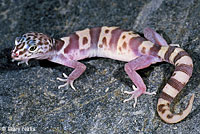
© Nathan Smith |
© Stuart Young |
|
|
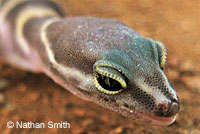 |
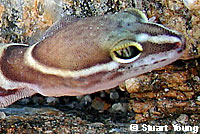 |
Desert Banded Gecko (C. v. variegatus)
Adults have large dark markings on the head
(but juvenile heads are plain or lightly spotted.)
The nuchal loop extending around the head
from the eyes is irregular or not present.
|
San Diego Banded Gecko (C. v. abbotti)
The head does not have large dark markings.
A
light-colored clearly-defined nuchal loop extends from
the eyes around the back of the head.
|
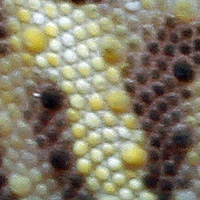 |
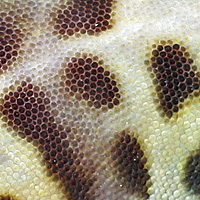 |
|
|
Peninsula Banded Gecko - C. s. switaki
Skin is smooth with small granular scales interspersed with larger tubercles. |
Desert Banded Gecko - C.variegatus
Skin is smooth with small granular scales that are not interspersed with larger tubercles. |
|
|
| |
|
|
|
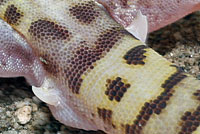
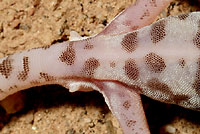
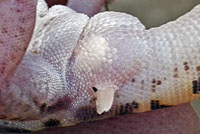
| Difference Between Males and Females |
 |
 |
 |
|
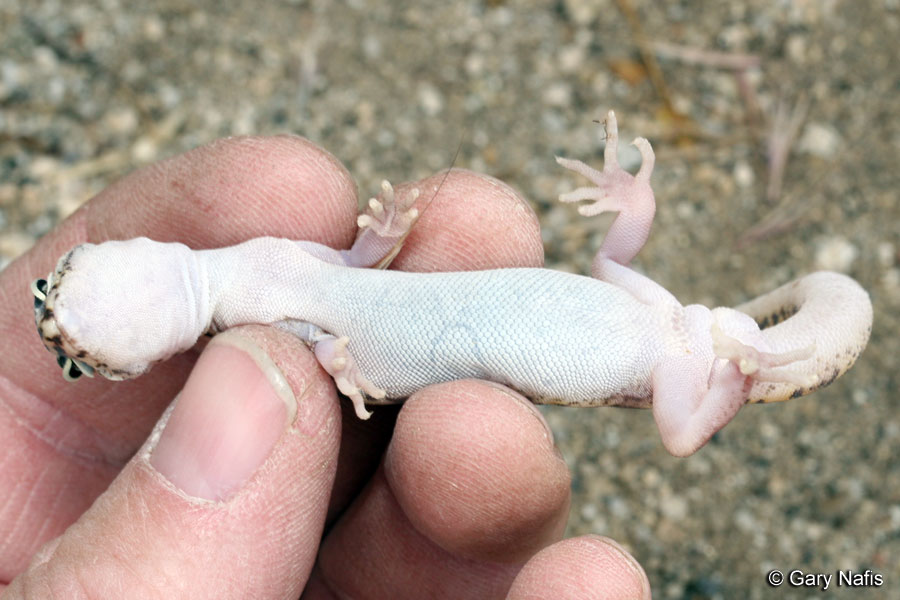
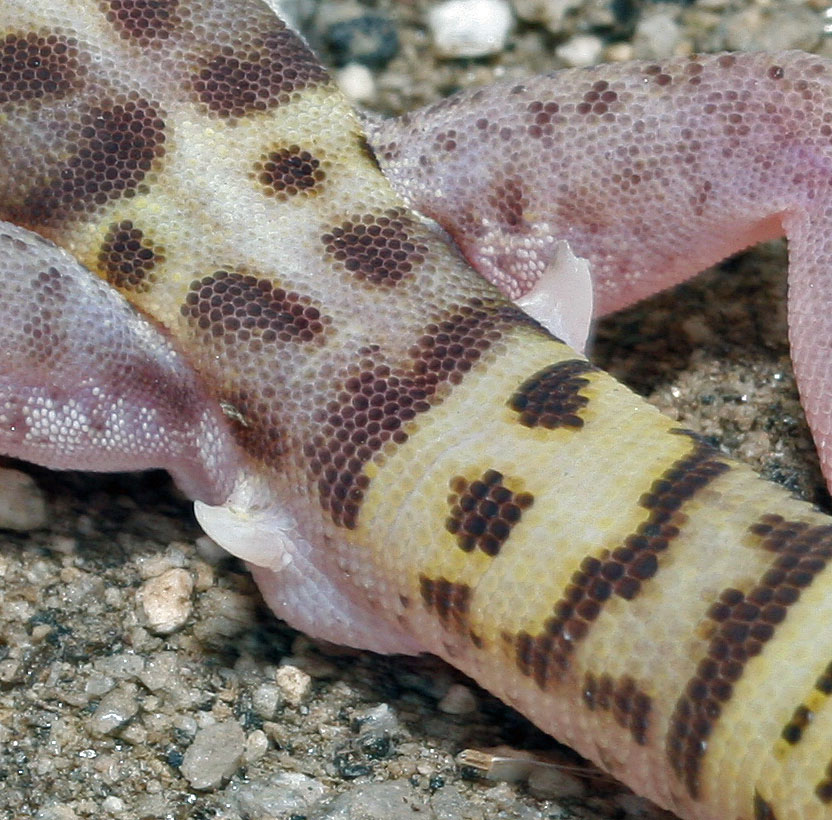
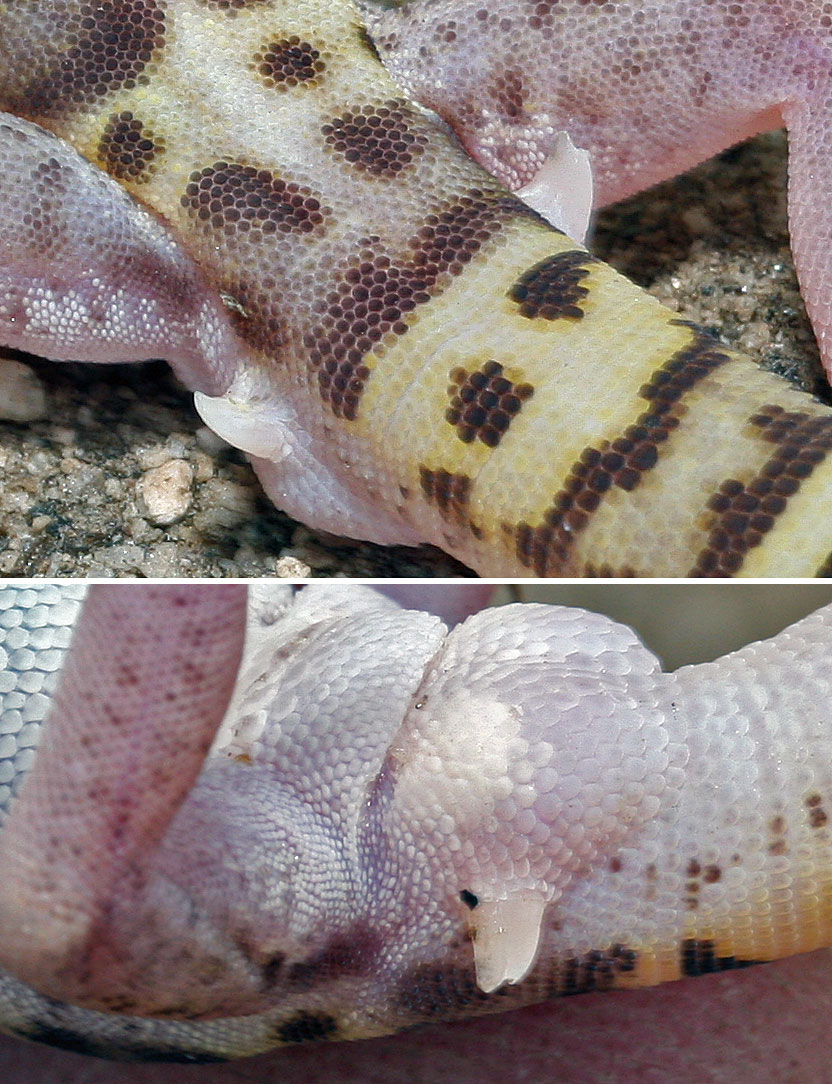
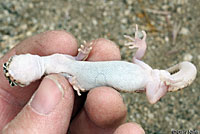
Males have spurs at the base of the tail. Females do not. Compare
|
Gravid adult female, Mono County. You can see some eggs in her lower body. © Keith Condon |
| |
|
|
|
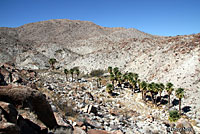
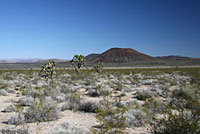
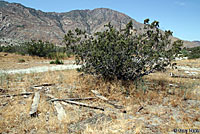
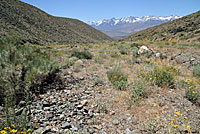
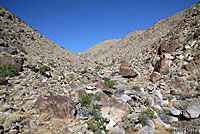
| Habitat |
 |
 |
 |
 |
Habitat, San Diego County
|
Habitat, San Diego County
|
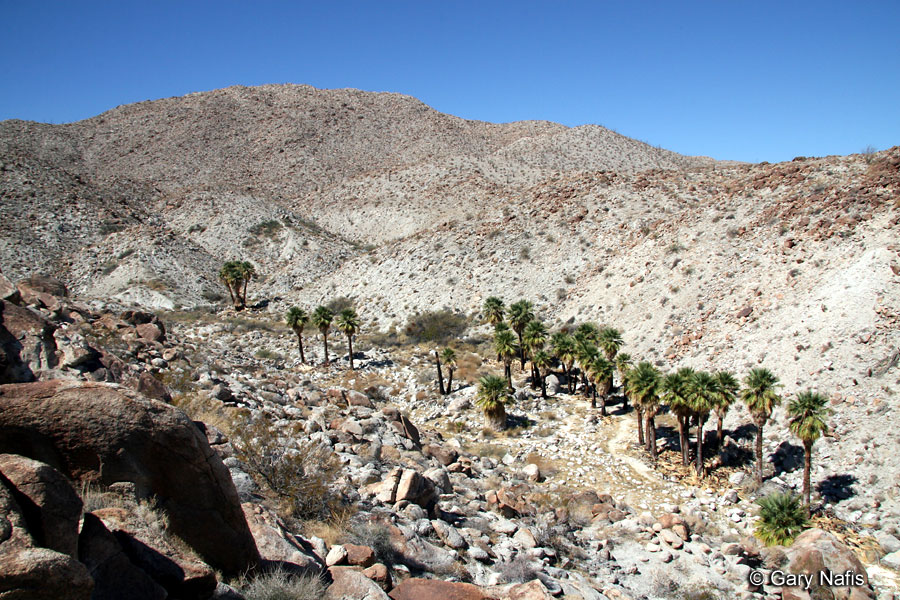
Habitat, San Bernardino County |
Habitat, Imperial County desert |
 |
 |
 |
 |
| Habitat, Riverside County |
Habitat, Inyo County |
Habitat, San Diego County |
Habitat, Imperial County |
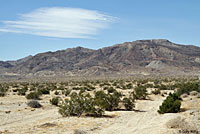 |
 |
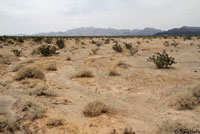 |
|
| Habitat, Imperial County |
Habitat, Riverside County
|
Habitat, Imperial County |
|
| |
|
|
|
| Short Videos |
|
 |
 |
 |
A night shot of a gecko crawling
slowly and waving its tail as a distraction. |
Three Desert Banded Geckos
out at night in the desert. |
Watch a short video of a Western Banded Gecko intergrade crawling along a boulder in Riverside County. |
This shows the detached tail of a Desert Banded Gecko wriggling rapidly in a defensive measure used to distract a potential predator to chase the tail and not the lizard's more vital head and body. The lizard was found on a highway after it was recently killed by a vehicle. The tail was partly severed and wriggling. When the tail was completely detached from the body, it continued wriggling as it was blown across the asphalt by a strong wind. Once the wriggling started winding down the tail was put into an automobile to keep it out of the wind as it slowly stopped moving. The video has been edited down from about 6 minutes. |
|
|
|
|
| Description |
| |
| Size |
2 - 3 inches long from snout to vent (5.1 - 7.6 cm).
|
| Appearance |
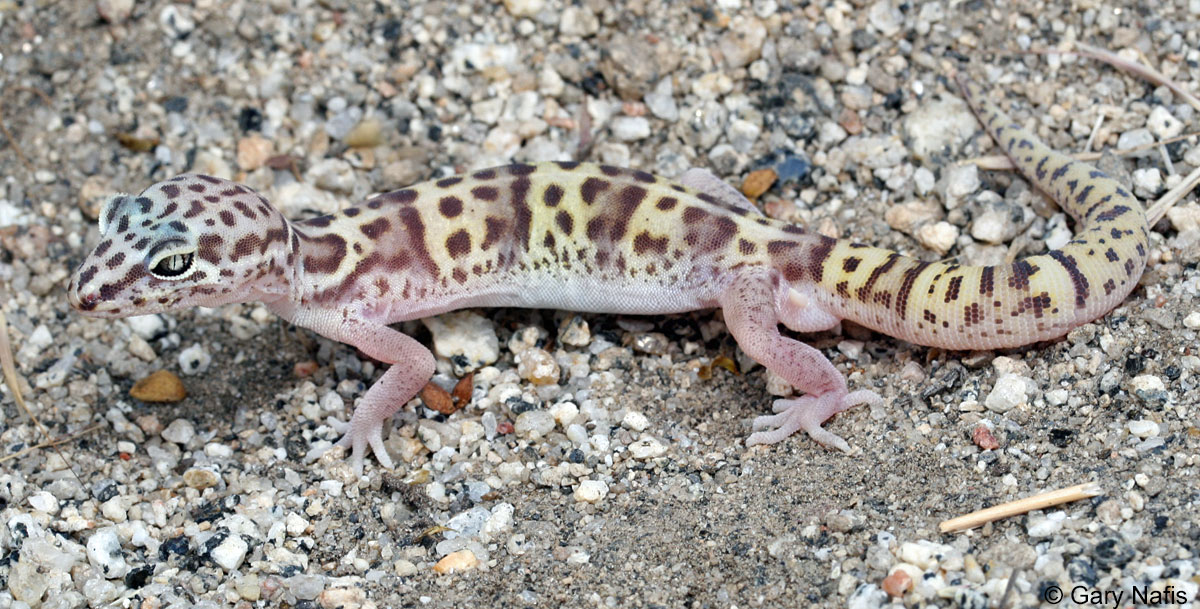
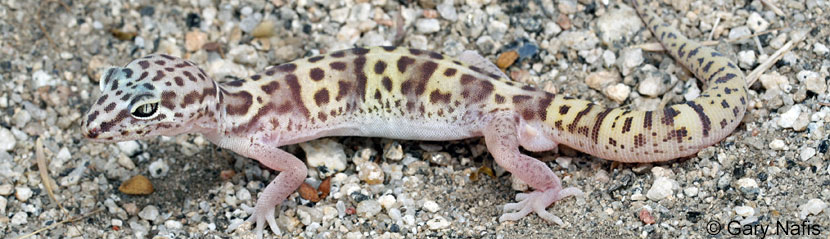
A small, slender lizard with movable eyelids and vertical pupils.
The head is triangular in shape and wider than the neck, and is usually spotted.
The skin is soft with fine granular scales (without tubercles).
Toes are long and slender.
Tail is constricted at the base.
|
| Color and Pattern |
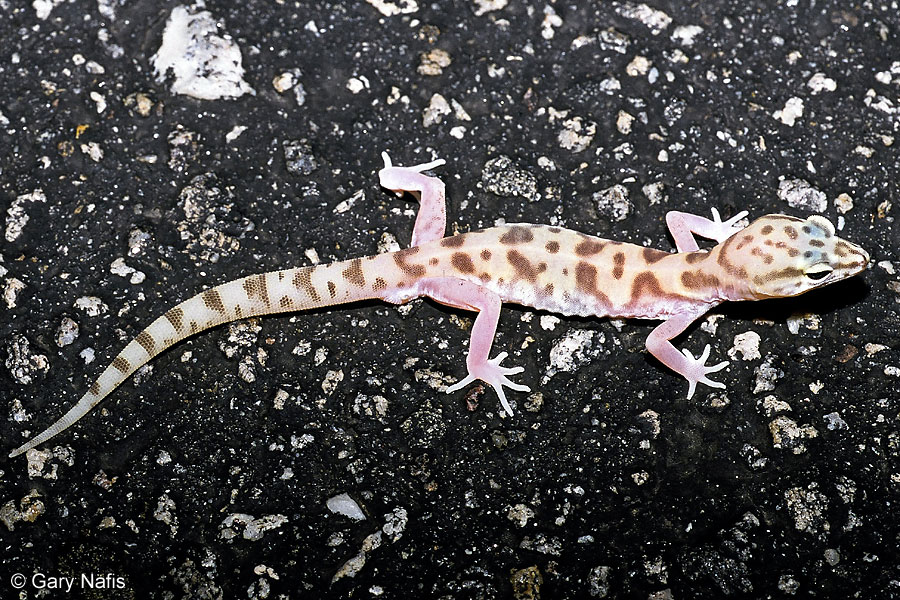
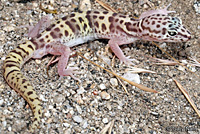
Color pattern is variable, with a pale yellow, pink, or light gray background, and tan or brown bands on the body and tail.
These bands may be broken into blotches, especially on older adults.
In some areas adults do not have broken bands, only spots.
The width of the dark bands is equal to or less than the width of the light areas.
|
| Male / Female Differences |
| Males have spurs on each side of the base of the tail. |
| Young |
Juveniles tend to have more well-defined unbroken bands than adults and few or no spots in-between the bands. The bands fade and break up with age.
The head is not as spotted as that of an adult.
Juvenile C. v. variegatus have the general appearance of adult and juvenile C. v. abbotti, and this sometimes causes confusion with their identification.
|
| Life History and Behavior |
Activity |
Mostly terrestrial. Not known to climb up walls like other species of geckos, but sometimes found up in large rock outcrops and in bushes and trees, occasionally several feet off the ground.
Active at night, hiding in burrows or under surface objects during daylight.
Hibernates through the winter (generally November to February).
Curls the tail up and waves it back and forth off the ground when stalking prey or as a defensive display when it feels threatened, similar to the tail waving display of a zebra-tailed lizard. The tail waving also mimics the tail and stinger of a scorpion. In Baja California (and possibly elsewhere in Mexico) geckos are called escorpiones (scropions) and they're thought to be venomous because of this scorpion mimicry.
When grasped, a bandedgecko may emit a short squeak. Listen.
|
| Defense |
The tail is expendable. Often geckos will wave the tail back and forth to encourage a predator to attack the moving tail instead of their more vital body and head. (You can see this tail-waving behavior in this short video.) When rough contact is made with the tail it can break off and writhe around on the ground for several minutes which may be long enough to distract a predator away from the lizard, giving it time to escape. With time, the tail will grow back, typically without the banding pattern matching the rest of the lizard's body.
More information about tail loss and regeneration. |
| Diet and Feeding |
| A variety of small invertebrates. |
| Reproduction |
Breeding occurs during April and May.
Females lay 1 or two eggs from May to September, which hatch in 45 days.
|
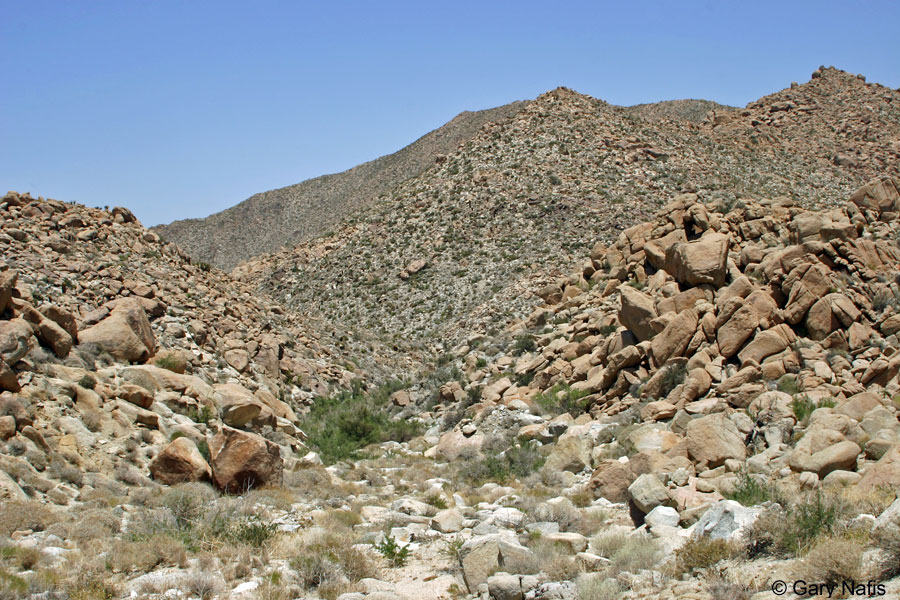
| Habitat |
Arid areas including creosote flats, sagebrush desert, piñon-juniper woods, chaparral. Prefers rocky areas, but may occur in rockless ares such as sand dunes.
|
| Geographical Range |
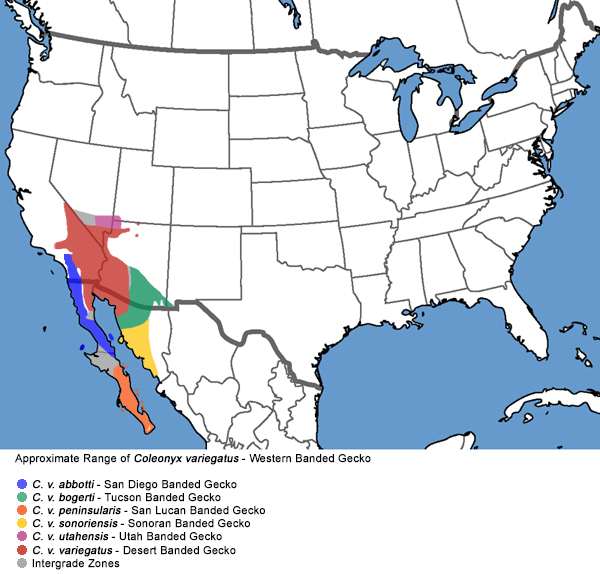
Species
The species Coleonyx variegatus ranges through most of Southern California north into the extreme southern part of Nevada and the southwestern tip of Utah, across northwest, southwest, and southeast Arizona into the bootheel of New Mexico, and south down the western edge of the state of Sonora, Mexico and down the entire length of Baja California.
Subspecies
In California the subspecies Coleonyx variegatus variegatus is found in the deserts - on the eastern edge of the Peninsular ranges from the Baja California border east to the Colorado River, north on the northern side of the Transverse ranges and along the eastern side of the Sierra Nevada Mountains to the Bishop area. It ranges inland through the Kern River Canyon to Granite Station in the western Sierra foothills and eastern edge of the San Joaquin Valley.
Beyond California this subspecies ranges into the southern tip of Nevada, across the western half of Arizona, into northeastern Baja California and mainland Mexico.
The northernmost Inyo County record west of the White Mountains and a first Mono County record for this lizard were documented in the southeastern Chalfant Valley in 2016 by Adam Clause, whose pictures of the geckos can be seen above. Herpetological Review 47(2), 2016
Possible Range of Intergradation With C. v. abbotti
The original description of the range of C. v. abbotti comes from Laurence M. Klauber's original description of the subspecies that was published in 1945:
"Range. -- Coastal and cismontane southern California and northern Lower California from the San Gabriel Mountains, Los Angeles County, south to the west slope of the San Pedro Martir Mountains of Lower California, Mexico. Also Cedros Island off the Pacific Coast of Lower California."
He included localities for the subspecies at Moreno in Riverside County and San Francisquito Hydroelectric Plant 2 in Los Angeles County.
He also included the map below, which, in addition to his comments, shows a small isolated population that appears to be the one on the west side of the Sierra Nevada in Kern County.
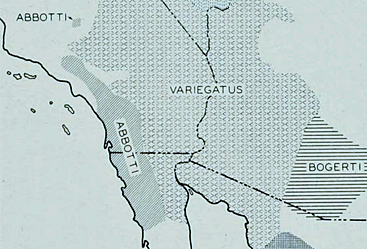
Stebbins (2003) and Lizards of the American Southwest (2009) both follow the part of this map that shows C. v. abbotti ranging throughout the Los Angeles basin and up the coast just into Ventura County. But the book California Amphibian and Reptile Species of Special Concern, (Thomsom et al. 2016) shows C. v. abbotti only in San Diego County and just barely over the Riverside County line. I have not seen any museum records to confirm the presence of this subspecies north of San Diego County except for one near Hemet in Riverside County, so I have decided to show the area north of San Diego County as a range of integradation with C. v. variegatus. (This is something I have not seen on any other range map and only represents my ideas.)
In the Santa Clarita area, and in Mono and Inyo Counties (and possibly other areas) some adult Coleonyx variegatus variegatus are marked with well-defined bands and may have a complete nuchal band or light collar marking, but often the heads are spotted and the bands have some spotting. These might just be regional variations where adults retain juvenile markings, though if you consider the old Stebbins (2003) map accurate, and consider that before human settlement C. v. abbotti might have once ranged through the L. A. basin north to Santa Clarita, the Santa Clarita area geckos could also be intergrades. Confusing details like these call into question the validity of the two subspecies. To add to this confusion, Thomson et al. (2016) refer to unpublished data (D. Leavitt, pg. 199) that shows that "In some areas. animals that are morphologically referable to C. v. abbotti are genetically more similar to C. v. variegatus...)
|
 |
Approximate distribution of Coleonyx variegatus - Western Banded Gecko
Dark Blue: Coleonyx variegatus abbotti - San Diego Banded Gecko
Red: Coleonyx variegatus variegatus - Desert Banded Gecko
-
Not found in California
Green: Coleonyx variegatus bogerti - Tucson Banded Gecko
Orange: Coleonyx variegatus peninsularis - San Lucan Banded Gecko
Yellow: Coleonyx variegatus sonoriensis - Sonoran Banded Gecko
Purple: Coleonyx variegatus utahensis - Utah Banded Gecko
|
| Elevational Range |
From below sea level to around 5,000 ft. (1,520 m).
|
| Notes on Taxonomy |
The species Coleonyx variegatus consists of four supspecies in the US, (two in California) with two more in Mexico.
"Leavitt (2015, Ph.D. dissertation, Univ. California, Davis and San Diego State Univ.) presented evidence, based on mt and nuDNA sequences, that C. v. variegatus and C. v. abbotti constitute lineages with limited bi-directional nuclear gene flow and that C. v. bogerti and C. v. utahensis are not differentiated from C. v. variegatus."
(SSAR Herpetological Circular No. 43, 2017.)
C. v. abbotti as a distinct species
In a taxonomic note about Coleonyx varigatus, Hansen and Shedd (2025) mention that Leavitt et al. (2015 and 2020) restricted the range of C. v. abbotti to cismontane San Diego County. "That form is a morphologically and genetically distinct subspecies that forms a narrow intergrade zone with the widespread C. v. variegatus (Leavitt et al. 2020). This pattern fits that of allopatric lineages now in secondary contact with only limited gene exchange and provides support for recognition of C. v. abbotti as a distinct species. Pending formal publication of taxonomic change, we continue to treat it as a subspecies of C. variegatus.
Alternate and Previous Names (Synonyms)
Coleonyx variegatus variegatus - Desert Banded Gecko (Stebbins 1966)
Coleonyx variegatus - Variegated Gecko (Smith 1946)
Coleonyx variegatus - Banded Gecko (Eublepharis variegatus; Variegated Gecko; Variegated Lizard) (Grinnell and Camp 1917)
Stenodacrylus variegatus (Baird, 1859)
|
| Conservation Issues (Conservation Status) |
| None |
|
|
Taxonomy |
| Family |
Gekkonidae (Eublepharidae) |
Geckos |
Boulenger, 1883 |
| Genus |
Coleonyx |
Banded Geckos |
Gray, 1845 |
| Species |
variegatus |
Western Banded Gecko |
(Baird, 1859 “1858”) |
Subspecies
|
variegatus |
Desert Banded Gecko |
(Baird, 1859) |
|
Original Description |
Coleonyx variegatus - (Baird, 1858) - Proc. Acad. Nat. Sci. Philadelphia, Vol. 10, p. 254
from Original Description Citations for the Reptiles and Amphibians of North America © Ellin Beltz
|
|
Meaning of the Scientific Name |
Coleonyx - Greek - koleos = sheath + onyx = nail, talon or claw - refers to sheathed claws
variegatus - Latin = of different colors - refers to contrasting elements of color pattern
from Scientific and Common Names of the Reptiles and Amphibians of North America - Explained © Ellin Beltz
|
|
Related or Similar California Lizards |
Peninsular Banded Gecko - C. switaki
San Diego Banded Gecko - C. v. abbottii
|
|
More Information and References |
California Department of Fish and Wildlife
Hansen, Robert W. and Shedd, Jackson D. California Amphibians and Reptiles. (Princeton Field Guides.) Princeton University Press, 2025.
Stebbins, Robert C., and McGinnis, Samuel M. Field Guide to Amphibians and Reptiles of California: Revised Edition (California Natural History Guides) University of California Press, 2012.
Stebbins, Robert C. California Amphibians and Reptiles. The University of California Press, 1972.
Flaxington, William C. Amphibians and Reptiles of California: Field Observations, Distribution, and Natural History. Fieldnotes Press, Anaheim, California, 2021.
Nicholson, K. E. (ed.). 2025. Scientific and Standard English Names of Amphibians and Reptiles of North America North of Mexico, with Comments Regarding Confidence in Our Understanding. Ninth Edition. Society for the Study of Amphibians and Reptiles. [SSAR] 87pp.
Samuel M. McGinnis and Robert C. Stebbins. Peterson Field Guide to Western Reptiles & Amphibians. 4th Edition. Houghton Mifflin Harcourt Publishing Company, 2018.
Stebbins, Robert C. A Field Guide to Western Reptiles and Amphibians. 3rd Edition. Houghton Mifflin Company, 2003.
Behler, John L., and F. Wayne King. The Audubon Society Field Guide to North American Reptiles and Amphibians. Alfred A. Knopf, 1992.
Robert Powell, Roger Conant, and Joseph T. Collins. Peterson Field Guide to Reptiles and Amphibians of Eastern and Central North America. Fourth Edition. Houghton Mifflin Harcourt, 2016.
Powell, Robert., Joseph T. Collins, and Errol D. Hooper Jr. A Key to Amphibians and Reptiles of the Continental United States and Canada. The University Press of Kansas, 1998.
Lemm, Jeffrey. Field Guide to Amphibians and Reptiles of the San Diego Region (California Natural History Guides). University of California Press, 2006.
Bartlett, R. D. & Patricia P. Bartlett. Guide and Reference to the Turtles and Lizards of Western North America (North of Mexico) and Hawaii. University Press of Florida, 2009.
Jones, Lawrence, Rob Lovich, editors. Lizards of the American Southwest: A Photographic Field Guide. Rio Nuevo Publishers, 2009.
Smith, Hobart M. Handbook of Lizards, Lizards of the United States and of Canada. Cornell University Press, 1946.
Taylor, Emily. California Lizards and How to Find Them. Heyday, Berkeley, California. 2025.
Joseph Grinnell and Charles Lewis Camp. A Distributional List of the Amphibians and Reptiles of California. University of California Publications in Zoology Vol. 17, No. 10, pp. 127-208. July 11, 1917.
|
|
|
The following conservation status listings for this animal are taken from the July 2025 State of California Special Animals List and the July 2025 Federally Listed Endangered and Threatened Animals of California list (unless indicated otherwise below.) Both lists are produced by multiple agencies every year, and sometimes more than once per year, so the conservation status listing information found below might not be from the most recent lists, but they don't change a great deal from year to year.. To make sure you are seeing the most recent listings, go to this California Department of Fish and Wildlife web page where you can search for and download both lists:
https://www.wildlife.ca.gov/Data/CNDDB/Plants-and-Animals.
A detailed explanation of the meaning of the status listing symbols can be found at the beginning of the two lists. For quick reference, I have included them on my Special Status Information page.
If no status is listed here, the animal is not included on either list. This most likely indicates that there are no serious conservation concerns for the animal. To find out more about an animal's status you can also go to the NatureServe and IUCN websites to check their rankings.
Check the current California Department of Fish and Wildlife sport fishing regulations to find out if this animal can be legally pursued and handled or collected with possession of a current fishing license. You can also look at the summary of the sport fishing regulations as they apply only to reptiles and amphibians that has been made for this website.
This animal is not included on the Special Animals List, which indicates that there are no significant conservation concerns for it in California.
|
| Organization |
Status Listing |
Notes |
| NatureServe Global Ranking |
|
|
| NatureServe State Ranking |
|
|
| U.S. Endangered Species Act (ESA) |
None |
|
| California Endangered Species Act (CESA) |
None |
|
| California Department of Fish and Wildlife |
None |
|
| Bureau of Land Management |
None |
|
| USDA Forest Service |
None |
|
| IUCN |
|
|
|
|