|
Venomous and Potentially Dangerous!
 |
 |
 |
| Adult, Riverside County |
Adult, San Diego County
© Ryan Shatto |
Adult, San Diego County © Bruce Edley |
|
 |
 |
Adult, Mecca Hills, Riverside County |
Adult, Santa Ana Mountains, Riverside County © 2005 Ken Pitts |
Adult, Imperial County
© John Stoklosa |
 |
 |
 |
Adult, San Bernardino County
© Michael Clarkson |
Juvenile, San Bernardino County
© Michael Clarkson |
Close-up of a high-contrast Adult,
San Diego County |
 |
|
|
Adult, Yuma County, Arizona
© Gary Nafis Specimen courtesy of Marty Feldner |
Adult, Yavapai County, Arizona |

|
|
|
| Rattle |
The great California herpetologist Laurence Klauber made his mark on a highway bridge in the San Diego County desert, writing: "L. Klauber caught Crotalus m. pyrrhus here, 1953"
It remained untouched for almost 50 years before it was painted over. |
|
| Habitat |
|
 |
|
Habitat, San Diego County |
Habitat, San Diego County
|
Habitat, Riverside County
|
| |
|
 |
Habitat, Riverside County |
Habitat, San Diego County |
| |
 |
|
| |
Habitat, San Diego County |
|
 |
Anza-Borrego State Park warning sign.
Click the picture to see more rattlesnake signs. |
| Short Video and Sound |
 |

|
|
| A coiled Southwestern Speckled Rattlesnake rattles, uncoils, and crawls into a bush. (The sound has been deleted in the middle due to excess background noise.) |
Click on the play button or the speaker to hear a rattlesnake rattling.
|
|
| |
Rattlesnakes are important members of the natural community. They will not attack, but if disturbed or cornered, they will defend themselves. Reasonable watchfulness should be sufficient to avoid snakebite. Give them distance and respect.
|
| |
|
Description |
| Venomous |
| The venom of this snake is potentially dangerous to humans. |
| Size |
| Adults are 23-52 inches in length (58-132 cm) averaging 2 - 3.5 feet. Young 8.5 - 10.5 inches. |
| Appearance |
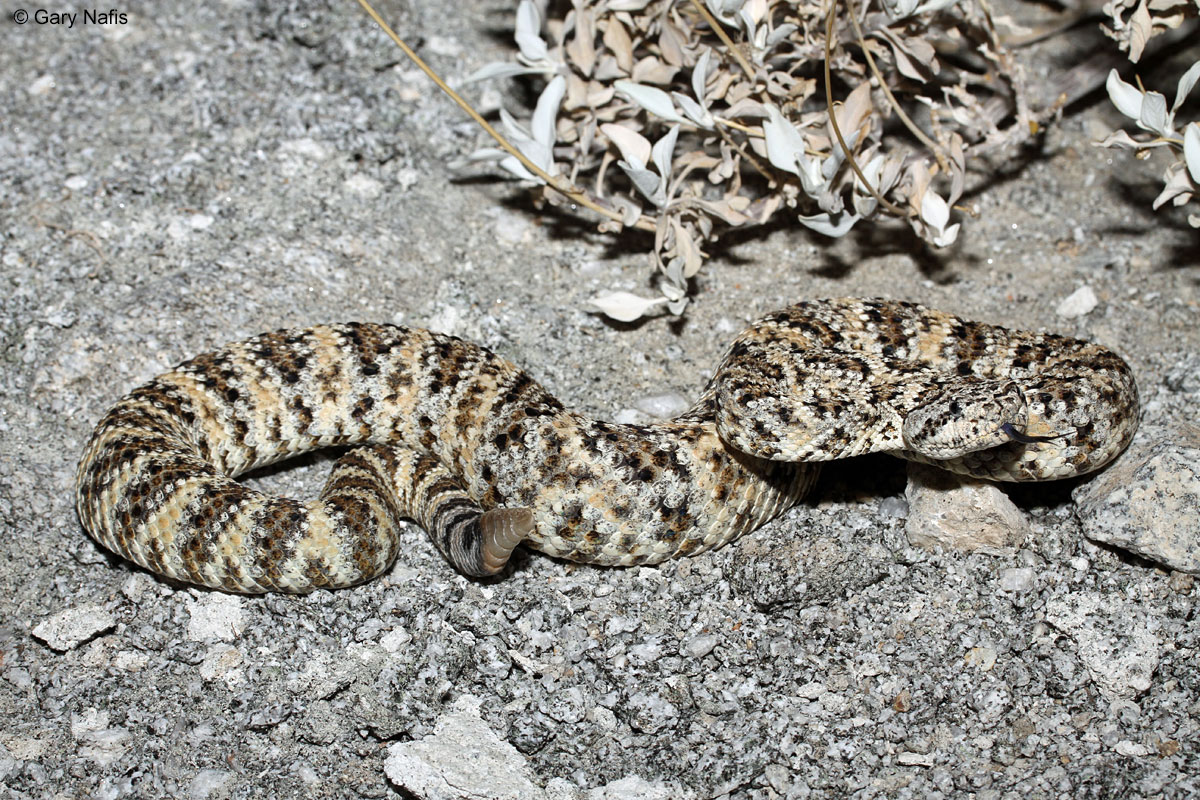
A heavy-bodied, venomous pit viper, with a thin neck and a large triangular head. Pupils are elliptical. Scales are keeled.
Shows a great variety of body coloration which usually allows the snake to blend into its environment, from off-white, yellowish, gray, tan, pinkish, pale orange, to brown. Snakes from dark lava bed environments can be almost all black. The body is marked with a vague pattern consisting of dark speckled banded markings. Dark and light rings surround a thick tail with a rattle on the end, consisting of loose interlocking segments. A new rattle segment is added each time the skin is shed. Newborn snakes do not have a rattle - just a single button which does not make a sound.
Heat sensing pits on the sides of the head help the snake to locate prey by their warmth. Long, hollow, movable fangs connected to venom glands inject a very toxic venom which quickly immobilize prey. The snake can control the amount of venom injected and the fangs are replaced if broken. Bites on humans are potentially dangerous without immediate medical treatment. Even a dead snake can bite and inject venom if the jaws reflexively open when they are touched. |
| Behavior |
Primarily nocturnal and crepuscular during periods of excessive daytime heat, but also active during daylight when the temperature is more moderate. Not active during cooler periods in Winter.
An ambush hunter, it may wait near lizard or rodent trails, striking at and releasing passing prey. The snake then follows the trail of the envenomated animal and swallows it whole. Prey is also found while the snake is actively moving.
When alarmed, a rattlesnake shakes its tail back and forth. The movement rubs the rattle segments together producing a buzzing sound which serves as a warning. Juveniles are born with only a silent button at the end of the tail. |
| Diet |
| Eats small mammals, lizards, and birds. |
| Reproduction |
| Live-bearing; young born July and August. |
| Range |
| Found throughout much of southern California, including coastal areas, north to aproximately the Mojave river, east into Nevada and extreme southwest Utah, south into Arizona and southern Baja California Norte. Sea level to 8,000 ft. (2,440 m). |
| Habitat |
| Associated mostly with arid areas strewn with rocks and boulders - alongside buttes, mesas, and desert outcroppings, but sometimes found on loose soil. Occurs in areas vegetated by sagebrush, creosote, thornscrub, chaparral, pinon-juniper woodland, succulent desert. |
| Taxonomic Notes |
MICHAEL E. DOUGLAS, MARLIS R. DOUGLAS, GORDON W. SCHUETT, LOUIS W. PORRAS, AND
BLAKE L. THOMASON (Genealogical Concordance between Mitochondrial and Nuclear DNAs Supports Species Recognition of the Panamint Rattlesnake (Crotalus mitchellii stephensi) Copeia, 2007(4), pp. 920–932) using molecular data, showed that Crotalus stephensi is a unique species, not a subspecies of Crotalus mitchellii. |
|
|
Taxonomy |
| Family |
Viperidae |
Vipers |
| Genus |
Crotalus |
Rattlesnakes |
| Species |
mitchellii |
Speckled Rattlesnake |
Subspecies
|
pyrrhus |
Southwestern Speckled Rattlesnake |
|
Original Description |
Crotalus mitchellii - (Cope, 1861) - Proc. Acad. Nat. Sci. Philadelphia, Vol. 13, p. 293
Crotalus mitchellii pyrrhus - (Cope, "1866" 1867) - Proc. Acad. Nat. Sci. Philadelphia, Vol. 18, p. 308
from Original Description Citations for the Reptiles and Amphibians of North America © Ellin Beltz
|
|
Meaning of the Scientific Name |
Crotalus - Greek - krotalon - a rattle - refers to the rattle on the tail
mitchellii - honors Mitchell, S. Weir
pyrrhus - Greek - pyrrhos - flame colored, reddish
from Scientific and Common Names of the Reptiles and Amphibians of North America - Explained © Ellin Beltz
|
|
Alternate Names |
None
|
|
Related or Similar California Snakes |
| |
|
More Information and References |
Natureserve Explorer
California Dept. of Fish and Game
SDNHM
Living With Rattlesnakes
Tucson Herpetological Society: Living With Venomous Reptiles pdf
California Department of Fish and Game: Rattlesnakes in California
University of California: Rattlesnakes Management Guide
Rattlesnake Bites
California Poison Control System:
Rattlesnake Bites
University of Arizona:
Rattlesnakes
Justin Schwartz' Rattlesnake Bite Story and Pictures
Sean Bush MD: Venom ER - When snakes strike!
Stebbins, Robert C. A Field Guide to Western Reptiles and Amphibians. 3rd Edition. Houghton Mifflin Company, 2003.
Behler, John L., & F. Wayne King. The Audubon Society Field Guide to North American Reptiles and Amphibians. Alfred A. Knopf, 1992.
Bartlett, R. D. & Patricia P. Bartlett. Guide and Reference to the Snakes of Western North America (North of Mexico) and Hawaii. University Press of Florida, 2009.
Bartlett, R.D. , & Alan Tennant. Snakes of North America - Western Region. Gulf Publishing Co., 2000.
Brown, Philip R. A Field Guide to Snakes of California. Gulf Publishing Co., 1997.
Ernst, Carl H., Evelyn M. Ernst, & Robert M. Corker. Snakes of the United States and Canada. Smithsonian Institution Press, 2003.
Wright, Albert Hazen & Anna Allen Wright. Handbook of Snakes of the United States and Canada. Cornell University Press.
Brown, Philip R. A Field Guide to Snakes of California. Gulf Publishing Co., 1997.Ernst, Carl. H. Venomous Reptiles of North America. Smithsonian Institution Press, 1999.
Hayes, William K., Kent R. Beaman, Michael D. Cardwell, and Sean P. Bush, editors. The Biology of Rattlesnakes. Loma Linda University Press, 2009.
Hubbs, Brian R., & Brendan O'Connor. A Guide to the Rattlesnakes of the United States. Tricolor Books, 2009.
Klauber, Laurence M. Rattlesnakes. University of California Press. (Abridged from the 1956 two volume Rattlesnakes:
Their Habits, Life Histories, and Influence on Mankind.) University of California Press, 1982.
Rubio, Manny. Rattlesnake - Portrait of a Predator. Smithsonian Institution Press, 1998.
Walls, Jerry G. Rattlesnakes: Their Natural History and Care. T. F. H. Publications, Inc., 1996.
|
|
|
The following status listings come from the Special Animals List which is published several times each year by the California Department of Fish and Game.
This animal is not included on the Special Animals List, which indicates that there are no significant conservation concerns for it in California.
|
Organization
|
Status Listing
|
| U.S. Endangered Species Act (ESA) |
|
|
| California Endangered Species Act (CESA) |
|
|
| California Department of Fish and Game |
|
|
| Bureau of Land Management |
|
|
| USDA Forest Service |
|
|
| Natureserve Global Conservation Status Ranks |
|
|
World Conservation Union - IUCN Red List
|
|
|
|
|