
A Guide to the Amphibians
and Reptiles of California

Books with Information About
Amphibians and Reptiles Found in California
This is a selected list of books with information about amphibians and reptiles that are found in California. Most of them cover herps found outside California as well. Some are outdated, but still contain interesting and useful information. You can find more books listed on the Resources and References page. There had not been one single field guide that exclusively covers California's amphibians and reptiles that I could recommend taking into the field until the arrival of the 2025 Princeton field guide California Amphibians and Reptiles by Robert W. Hansen and Jackson D. Shedd. If I could only carry one, it's the one I would take. There are a few other recent field guides that include all of the herps of California that are also still useful: Field Guide to Amphibians and Reptiles of California, the 2012 guide by Robert Stebbins and Samuel M. McGinnis; the 2018 Peterson Field Guide to Western Reptiles and Amphibians Fourth Edition by Samuel M. McGinnis and Robert Stebbins (which also covers all of the herps west of the Rocky Mountains); and R. D. Bartlett's 2009 three volume Guide and Reference to the Snakes, Turtles and Lizards, and Amphibians of Western North America. I also still like to use the 2003 3rd edition of Robert Stebbins Peterson field guide. There are also several guides that cover only snakes, lizards, or amphibians which you can see below. And there are many other excellent guides that cover more than California which, when put together, will cover all or most of the species in California, including Lang Elliott's The Frogs and Toads of North America, Petranka's Salamanders of the United States and Canada, and Jones, Lawrence, and Lovich's Lizards of the American Southwest, which covers almost all of the lizard species found in California, and Ernst et al's Turtles of the United States and Canada. And there are probably some newer ones that I haven't seen yet. It's hard (and expensive) to keep up with everything available. In most cases, if you click on a book cover image it will take you to a link where you can find out more about the book or purchase it. |
||
| Books Specifically About California Amphibians and Reptiles | ||
 |
 |
 |
| Robert W. Hansen and Jackson D. Shedd. California Amphibians and Reptiles. (Princeton Field Guides.) Princeton University Press, 2025. |
Stebbins, Robert C., McGinnis, Samuel M. Field Guide to Amphibians and Reptiles of California: Revised Edition. (California Natural History Guides) University of California Press, 2012. |
Taylor, Emily. California Snakes and How to Find Them Heyday, Berkeley, California. 2024. |
| This is by far the best field guide covering California's amphibians and reptiles that I've seen, and the one you will want to use. It's a bit larger than many field guides, with a thick cover meant to withstand field use, but it's still light enough that everyone should want to take into the field or your vehicle. (No field guide wants to be left at home.) The benefit of all those extra pages is an outstanding collection of illustrations, range maps, and species accounts that cover every known herp in the state and a few previously unknown ones. The large detailed range maps are designed to be accessible to those with red green colorblindness, and they show county lines, which greatly increases their usefulness. The color illustrations of the animals, most of which are photographs, are all shown on a white background to make them stand out. They also show juveniles of many species along with some common variations in appearance for some species, which can help very much with identification. Even the aquatic larvae of frogs and salamanders are illustrated in color. There is a wealth of information presented for each animal in the species accounts, including descriptions of habitat, range and elevation, activity and behavior, reproduction, diet, similar species, identification details, and conservation issues. Amphibian and reptile taxonomy can be confusingly variable, so it is to be expected that a few of the names used here are different from what we've seen elsewhere. The reasons for these changes are well-explained in the taxonomic notes section. Some field guides put everything together in one section, but this guide separates the species accounts, color illustrations, and range maps into three distinct sections. This format allows for larger illustrations and range maps, and more detailed species accounts, but it does take a more effort to navigate back and forth between the sections, because the plates and maps are not cross-referenced. Using the color-coding on the top left corner of each page, the full index in the back, and the page number cross-referencing found in the species account will help you get around easier, though the small font in italics that is used in the index makes it difficult for my old eyes to use. The authors have told me they are now working on a field guide to the entire West, which promises to be another winner. Full disclosure: I know both of the authors, they have contributed to this web site and they sent me a free copy of the book, but I was not involved in making it and I don't benefit if you buy it, other than how we all benefit when publishers find they can still make a profit from selling field guides like it and continue to publish them. |
Written with Samuel McGinnis, this is an extensive update of Robert Stebbins' 1972 California field guide with his drawings and photographs for most species. The range maps and pictures are now on the same pages as the species description instead of in separate sections as they were in the past. The authors have chosen not to illustrate the range of the individual subspecies on the range maps (except for the Ensatina) but they do describe the ranges in the text. In several examples, they show more than one species together in one range map without illustrating the individual ranges, which could be confusing. This book has some flaws, but in 2012 it was the first complete book about California's amphibians and reptiles to be published in 40 years. |
This is a great concise popular science guide to all of the snakes established in the wild in California that'll make you appreciate them more whether you're a snake novice or veteran. (I wish it had been available when I was starting out.) The author, Emily Taylor, "...a staunch advocate for improving the public image of snakes, especially rattlesnakes" explains her goal in the preface: "In addition to helping you learn how to find, observe, and identify the snakes around you, I want you, the budding snake enthusiast, to learn how to interact with wildlife in a responsible manner." She encourages the reader to pick up and examine the harmless snakes, quoting Sam Sweet: "Field herpetology cannot be (and should not be) reduced to birdwatching" but she also persuades us to also try to observe snake behavior by watching them in the wild whenever they let us. She also encourages reporting unusual snakes on iNaturalist. Taylor has written college biology textbooks, taught college classes, and conducted field research, so her expertise is apparent throughout the book, but she also expresses an enthusiasm for the subject that is lacking in most field guides which makes it more entertaining to read than a typical reference. There is enough description of each snake's appearance, behavior, and habitat preferences to help you find and identify snakes, but it's not meant to be a detailed field guide. There are no range maps or footnotes and there is not too much description of technical details and taxonomy to confuse the reader. I think it's best to read it cover to cover to get some familiarity with all of the species, then you can use it more easily as a reference or as an identification guide to put in your backpack. The book includes lots of useful information about how to go about finding snakes, but except for one rattlesnake, it doesn't give any exact locations for where to search. Instead, it helps the reader figure out what type of habitat to search, when to search, and what search methods can be useful. There aren't a lot of photographs in it - one for each species (many by Marisa Ishimatsu) - but they are excellent, with many of them showing both the snake and its habitat. |
 |
 |
 |
| Taylor, Emily. California Lizards and How to Find Them Heyday, Berkeley, California. 2025. |
Flaxington, William C. Amphibians and Reptiles of California: Field Observations, Distribution, and Natural History. Fieldnotes Press, Anaheim, California, 2021. |
Robert C. Thomson, Amber N. Wright, and H. Bradley Shaffer. California Amphibian and Reptile Species of Special Concern. California Department of Fish and Wildlife. University of California Press, 2016. |
| This is a great concise guide to all of the lizards established in California, including natives and non-natives. It makes a great companion to Taylor's California Snakes book (discussed above) and it follows the same format and goal. It's a basic introduction to California lizards that is not meant to be a complete field guide, but it's complete and concise enough to use as one if you want. There is typically only one photo for each species, but most of them are excellent, with some of them showing both the lizard and its habitat. There is advice about how to find most of the species and where to look, but the book does not include specific areas to search, except in a few cases. The reader is encouraged to search for the nearly sixty species of California lizards to watch them, instead of catch them. Most lizards are diurnal and conspicuous, so it's possible to observe their behavior with a little patience if you don't scare them away by trying to catch them first. But she also knows that anyone with an interest in lizards will want to pick them up to see them close-up, so she briefly discusses using a pole with a noose on the end to catch them, (which she calls a "lasso") and explains how to handle them so they are not injured. Taylor's website shows that "California Amphibians and How to Find Them" is scheduled to be published in the Spring of 2026. I look forward to reading it, also. |
This is an unusual hybrid of a field guide and a list of the author's personal field observations. It contains descriptions, photos, and distribution maps for all of the native species of amphibians and reptiles found in California, (and some of the non-native species) including some newly-described species that I have not yet seen discussed in other books. There's also an illustrated section describing 19 geographic regions in the state, followed by a description of the different environments within those regions. The bulk of the book contains descriptions, range maps, and photographs of each species, but at the end there is a list of thousands of the author's field observations listing the locations where each species was observed over more than 30 years of fieldherping. The range maps provide a good representation of the distribution of a species (but not subspecies) and they also include markings that show locations where the author has found a species and its subspecies when there are any. |
This excellent book covers only the threatened herps species of California, but that's a lot of them. It's worth looking at for the very detailed range maps alone, but the excellent comments on identification, life history, habitat, distribution, status, and threat management make it superior to other field guides. You should be able to download the full book from this web page: https://wildlife.ca.gov/Conservation/SSC/Amphibians-Reptiles |
 |
 |

|
| Stebbins, Robert C. California Amphibians and Reptiles. The University of California Press, 1972. |
Lemm, Jeffrey. Field Guide to Amphibians and Reptiles of the San Diego Region (California Natural History Guides). University of California Press, 2006. |
Brown, Philip R. A Field Guide to Snakes of California. Gulf Publishing Co., 1997. |
| This is the original version of the 2012 Stebbins/McGinnis California field guide. It's out of date and out of print, but there is still some interesting historical information in it. | An excellent, well-illustrated guide to one of the most interesting herping regions of California. Many of the species covered in this book are found throughout southern California, making it a great resource for learning about all of southern California's herps. |
This is a concise description of all of California's Snake species and subspecies, including photos, range maps and very good drawings which aid in identification. It was written in 1997 so there have been some taxonomical changes, but it's still worth using. |
 |
 |
 |
| Sanborn, Sherburn R. The Lizard-Watching Guide - The Common Lizards of Southern California's Mojave and Colorado Deserts. Lorraine Press, 1994. |
Basey, Harold E. Discovering Sierra Reptiles and Amphibians. Yosemite Association and Sequoia Natural History Association, 1976, 1991. |
Shedd, Jackson D. Amphibians and Reptiles of Bidwell Park. Quadco Printing, Chico. 2005 |
| This neat little booklet has excellent photos and information about California desert lizards including a mention of some of the locations where you can find them to photograph. The book might not be easy to find, but they might still have copies of it at the Anza-Borrego Desert State Park Visitor Center where I got mine way back in 1994. |
A fine little illustrated pamphlet covering the herps of the Sierra Nevada Mountains and foothills, including elevational range diagrams. | I wish there was a herp guide like this to every park in California. This guide includes excellent drawings and accounts of all of the species of this Northern Sierra Foothills park, which are basically the same species that are found throughout much of the Sierra Nevada Foothills. |
| Books Containing Information About California Amphibians and Reptiles | ||
 |
 |
 |
| Macey, J. Robert and Theodore Papenfuss."Herpetology." The Natural History of the White-Inyo Range Eastern California. Ed. Clarence Hall. University of California Press, 1991. | Schoenherr, Allan. A Natural History of California. The University of California Press. 1992. |
Schoenherr, Allan A. Natural History of the Islands of California. The University of California Press. 2003. |
| I used the herpetology chapter of this book extensively when I first started exploring the region. There is excellent information about the herps of the region, with good locality information and range maps. | Good coverage of the herpetofauna of California and their place in the various ecosystems found in the state. I recommend it highly as a great introduction to California's natural history. | Contains a lot of good information about the herps found on California's Islands. |
 |
 |
 |
| Stebbins, Robert C. A Field Guide to Western Reptiles and Amphibians. 3rd Edition. Houghton Mifflin Company, 2003. |
Samuel M. McGinnis and Robert C. Stebbins. Peterson Field Guide to Western Reptiles & Amphibians. 4th Edition. Houghton Mifflin Harcourt Publishing Company, 2018. |
Robert Powell, Roger Conant, and Joseph T. Collins. Peterson Field Guide to Reptiles and Amphibians of Eastern and Central North America. Fourth Edition. Houghton Mifflin Harcourt, 2016. |
| The third edition of the classic guide to western herps from the great California Herpetologist, with drawings and range maps, covering all of the reptiles and amphibians found in California as well as western North America. It is small enough to take into the field, too. I used it so much, I made my own quick-index to paste on the inside cover so I could find information faster. You can download it here. I also enjoy looking through Robert Stebbins' older field guides, including his first published in 1954, and the earlier editions of his Peterson field guides - the first edition in 1966 and the second in 1985. |
The fourth edition of the classic guide to western herps from Samuel McGinnis and the great but now deceased California Herpetologist Robert Stebbins, with drawings and range maps, covering all of the reptiles and amphibians found in California as well as western North America. It is small enough to take into the field, too. The taxonomy has mostly been updated, and the format has changed to match the recent Eastern Peterson field guide, with the range maps and some illustrations now found together with the species descriptions. There are a lot more pictures of the animals, but the plates with Stebbins' classic drawings are still here. Nevertheless, there are some omissions and some glaring mistakes, including some mislabled pictures and the range map for slender salamanders in the southern Sierra Nevada, that make it difficult to recommend this book. |
This is a very welcome update to the previous guide published in 1998 covering herps east of the Rocky Mountains. The pictures and information and taxonomy have all been updated of course, but the basic layout of the book has also been greatly improved making it easier to use. The illustrations are all now separated so that you can compare all of the similar herps, then go to the individual accounts for each species, where you will also find the range maps and some small photos. |
 |
 |
 |
| Jones, Lawrence, Rob Lovich, editors. Lizards of the American Southwest: A Photographic Field Guide. Rio Nuevo Publishers, 2009. |
Lang Elliott, Carl Gerhardt, and Carlos Davidson. Frogs and Toads of North America, a Comprehensive Guide to their Identification, Behavior, and Calls. Houghton Mifflin Harcourt, 2009. |
St. John, Alan D. Reptiles of the Northwest: Alaska to California; Rockies to the Coast. 2nd Edition - Revised & Updated. Lone Pine Publishing, 2021. |
| The best guide to our lizards I've seen. It covers every species of lizard found in California, as well as the rest of the west, including some coverage of Baja California. (The title could be "Lizards of the American West.") It includes a chapter with information about where to go to find lizards and the book puts a strong emphasis on conservation and environmental ethics when herping. Here's the official blurb: "Lizards of the American Southwest covers all 96 species found in California, Nevada, Arizona, New Mexico, Utah, Colorado, and Texas west of the Pecos River. Learn where to find lizards and how to identify them. Includes detailed information on habitat, natural history, taxonomy, viewing tips, plus hundreds of photos, illustrations, and maps." Full disclosure: this book uses a few of my pictures, but I don't profit if you buy it. |
This book is stunning in the quality of its design, printing, photography, and recordings, and in its scope. It covers all of the frogs and toads of North America, north of Mexico with sound recordings and color pictures of them all, including many full-page glossy pictures, all for a cover price of only $19.95. The CD is probably worth that much, alone. It only has recordings of advertisement calls, which are all you need to know really, but you may still want to have other regional cds which illustrate more types of calls. Full disclosure: this book uses a few of my pictures and the cd that comes with it also uses several of my sound recordings of frogs and toads, but I don't profit if you buy it. |
Great photos, excellent accounts, and lots of interesting stories from the field. One of the best field guides out there. Includes good identification tips. The "Northwest" here has been defined somewhat unusually in that it extends south into California to the Central Valley just below lake Shasta, so it covers many California species. It also extends east into northern Utah and Colorado and western Wyoming, just far enough to add a few more interesting lizards and snakes. Originally published in 2002, the second edition expands on it, adding a few new species and updating some of the taxonomy. |
 |
 |
 |
| Jones, Lawrence L. C. , William P. Leonard, Deanna H. Olson, editors. Amphibians of the Pacific Northwest. Seattle Audubon Society, 2005. |
Ernst, Carl H., Roger W. Barbour, and Jeffrey E. Lovich. Turtles of the United States and Canada. Smithsonian Institution Press, 1994 |
Petranka, James W. Salamanders of the United States and Canada. Smithsonian Institution, 1998. |
| A great update of the previous guide. It has expanded its definition of "Pacific Northwest" to include the northern California Coast and the Siskiyou Mountains. This adds a few more California salamanders to their list, which includes many amphibians found in California, including the recently discovered (2005) Scott Bar Salamander. (It also has some great pictures of transformed Cope's Giant Salamanders.) |
This guide covers all of the turtles found in California, native and introduced, and in the rest of North America north of Mexico, with illustrations, range maps, and excellent descriptions. A second edition was published in May, 2009, with updated information and revised species names: Carl H. Ernst and Jeffrey E. Lovich. Turtles of the United States and Canada. Second edition. Johns Hopkins University Press, 2009. |
This book covers all of the salamanders of the US, including all of those described in California before 1998, with some of the most detailed species accounts available for California species. |
 |
 |
 |
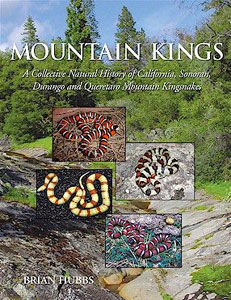
| Hubbs, Brian. Mountain Kings - A Collective Natural History of California, Sonoran, Durango and Queretaro Mountain Kingsnakes. Tricolor Books, 2004. |
Mulks, Mitchell. Zonata, the California Mountain Kingsnake. LM Digital, 2004. |
Hubbs, Brian. Common Kingsnakes, A Natural History of Lampropeltis getula. 2009. |
| Everything you didn't know you needed to know about Mountain Kingsnakes, and more. A fun and informative read by a veteran herper who is obsessed by these snakes. Anyone who wants to learn where and how to find mountain kingsnakes should read this book. Full disclosure: this book uses one of my pictures, but I do not make any money if you buy it. It also includes an inaccurate account of one of my outings with the author. I forgive him for taking creative license in trying to make me look like a fool, but I seem to do that well enough without his help. |
Outstanding photos and excellent descriptions of one of the most beautiful and sought-after California snakes. (The companion book on Lampropeltis alterna - the Gray-banded Kingsnake, is also highly recommended.) |
All you could ever want to know about common kingsnakes, including over 500 photos of snakes and their habitat, range maps, coverage of all subspecies and all known naturally occurring aberrant morphs (70 of which are found in California) and non-natural designer morphs, field stories, explanations of field techniques, detailed range maps, and a reference bibliography. It was written before Lampropeltis taxonomy was changed, but don't let that stop you. To get this book, email tricolorbrian@hotmail.com. |
 |
 |
 |
| Bartlett, R. D. & Patricia P. Bartlett. Guide and Reference to the Amphibians of Western North America (North of Mexico) and Hawaii. University Press of Florida, 2009. |
Bartlett, R. D. & Patricia P. Bartlett. Guide and Reference to the Snakes of Western North America (North of Mexico) and Hawaii. University Press of Florida, 2009. |
Bartlett, R. D. & Patricia P. Bartlett. Guide and Reference to the Turtles and Lizards of Western North America (North of Mexico) and Hawaii. University Press of Florida, 2009. |
| Combined, these three books are a comprehensive coverage of California's herps, with photographs of every species, range maps, and species descriptions, including coverage of all of the recent taxonomic changes (as of 2009). A nice addition is the inclusion of short descriptions of some of the author's experiences when hunting for herps in the field. Full disclosure: the amphibians book uses one or more of my pictures, but I don't profit if you buy it. |
||
 |
 |
 |
| Bartlett, R.D. , & Alan Tennant. Snakes of North America - Western Region. Gulf Publishing Co., 2000. |
Andrew T. Holycross, Thomas C. Brennan, and Randall D. Babb. A Field Guide to Amphibians and Reptiles in Arizona Second Edition. Arizona Game and Fish Department, 2022. |
Brown et. al. Reptiles of Washington and Oregon. Seattle Audubon Society, 1995. |
| This guide covers all of the snakes in California and the west (including subspecies), with photographs, range maps, and species accounts. (A companion to the Snakes of North America - Eastern Region.) Lots of good information about breeding and reproduction. |
This is an update of the 2006 book, with outstanding photographs and identification tips and a great section about Arizona's various habitats. It's an excellent model for state field guides - small, concise, and beautifully illustrated, with the description, pictures, and range maps all found together with each species. |
A great introduction to the reptiles of the northwest, including some from California. Excellent photography and detailed descriptions of many species that also occur in California. |
 |
 |
 |
| Michael Lannoo (Editor) Amphibian Declines: The Conservation Status of United States Species. University of California Press, June 2005. |
Robert L. Bezy. Night Lizards: Field Memoirs and a Summary of the Xantusiidae. ECO Herpetological Publishing & Distribution. 2019. |
Ronald Altig and Roy W. McDiarmid. Handbook of Larval Amphibians of the United States and Canada. Comstock Publishing Associates, 2015. |
| This is the best single printed source of information about the life histories of California's amphibians of which I'm aware. The first half of this massive book is loaded with essays on amphibian conservation. The second half contains very thorough and detailed species accounts for all of the amphibians of the U. S. A. along with excellent range maps.The accounts do not include a physical description of the appearance of each species, but they cover just about everything else you would want to know. Modified versions of many of these accounts can be read on AmphibiaWeb. |
Species accounts with range maps for all six species of night lizards found in California and all other species, historical perspectives on herpetologists who studied night lizards, and lots of entertaining accounts of herping adventures around the world, including a look at Baja California in the 1960s when it was an unpaved wilderness, coming face-to-face with an African cobra, and many adventures in Mexico and Central America searching for night lizards. | |
 |
 |
 |
| Degenhardt, William G., Charles W. Painter, & Andrew H. Price. Amphibians and Reptiles of New Mexico. University of New Mexico Press, 1996. |
Rossman, Douglas A., Neil B.Ford, & Richard A. Siegel. The Garter Snakes - Evolution and Ecology. University of Oklahoma Press, 1996. |
Conant, Roger and Joseph Collins. A Field Guide to Reptiles and Amphibians -Eastern and Central North America. Houghton Mifflin Company, 1998. |
| Outstanding dot-locality range maps, photos, and extensive accounts. A model for other state books. A number of California species are found as far east as New Mexico. | A complete guide to the Garter Snakes, including all of those found in California, with very extensive accounts. | This is an older edition of the field guide for the rest of the USA not covered by the Stebbins Field Guide, including all states east of the Rocky Mountains. (It was revised in 2016. See above.) A few species found in California range far enough east that they are also covered in this guide. It also covers a few non-native species that have been introduced into California. |
 |
 |
 |
| Rubio, Manny. Rattlesnake - Portrait of a Predator. Smithsonian Institution Press, 1998. |
Sherbrooke, Wade C. Introduction to Horned Lizards of North America. University of California Press, 2003. |
Hubbs, Brian R., & Brendan O'Connor. A Guide to the Rattlesnakes and other Venomous Serpents of the United States. Tricolor Books, 2011. |
| Lots of good pictures and information about buzzworms in this nicely-designed book. |
This book covers all of the Horned Lizards (including Mexican species) with lots of great natural history photographs of horned lizards, and their predators. |
The authors' original 2009 guide to the rattlesnakes of the United States has been expanded to cover all of the venomous serpents of the United States, including Rattlesnakes, Coral Snakes, Copperheads, and Cottonmouths, with 170 color pictures and 42 range maps. |
 |
 |
 |
| Klauber, Laurence M. Rattlesnakes. University of California Press. (Abridged from the 1956 two volume Rattlesnakes: Their Habits, Life Histories, and Influence on Mankind.) University of California Press, 1982. |
Klauber, Laurence M. Rattlesnakes: Their Habits, Life Histories, and Influence on Mankind. University of California Press, 1956. (Hardcover 2 volume set.) (Second Edition, 1997.) |
Hayes, William K., Kent R. Beaman, Michael D. Cardwell, and Sean P. Bush, editors. The Biology of Rattlesnakes. Loma Linda University Press, 2009. |
| The classic guide to rattlesnakes by the late great California Herpetologist. |
"Due in part to the toxic nature of their venom, rattlesnakes comprise the most popular and well-studied group of snakes in the world. The Biology of Rattlesnakes showcases the finest research to date by investigators encompassing an enormous breadth of expertise. With 50 original contributions from 98 authorities covering a diverse range of topics, this landmark volume will be looked upon as authoritative for years to come. The beautiful, full-color plates depicting many of the more than 30 rattlesnake species add a tasteful touch." |
|
 |
 |
 |
| Joshua M. Parker, Ph.D & Simone Brito, M.S. Reptiles & Amphibians of the Mojave Desert: A Field Guide. Snell Press, 2013. | Ernst, Carl H. and Evelyn M. Ernst. Venomous Reptiles of the United States, Canada, and Northern Mexico: Heloderma, Micruroides, Micrurus, Pelamis, Agkistrodon, Sistrurus (Volume 1) Johns Hopkins University Press. 2011 |
Ernst, Carl H. and Evelyn M. Ernst. Venomous Reptiles of the United States, Canada, and Northern Mexico: Crotalus (Volume 2) Johns Hopkins University Press. 2011 |
| This is a very nice compact field guide to the reptiles and amphibians found in the Mojave Desert, made with an emphasis on the identification of animals seen in the field. The book's compact size and excellent layout will make it easy to use in the field: A different color code for Salamanders, Frogs, Turtles, Lizards, and Snakes corresponds to a handy index that folds backwards off of the front cover to make it very easy to look up a particular animal. There are two pages per species, with the common and scientific names in bold on the top of the left page followed by a short overview of the animal. Two color-coded tabs on the edge of the page offer quick access to information - one showing if an animal is harmless, mildly venomous, or dangerously venomous, and the second showing the animal's IUCN conservation status - Not Yet Assessed, Least Concern, Vulnerable, or Endangered. Next is a section with brief descriptions of size, distinguishing features, similar species, subspecies, habitat, activity period, diet, reproduction, young, and likelihood of encounter. (Many pages could have been written on these subjects, but the emphasis here is on the basics needed for field use.) There are excellent range maps at the bottom of the page, one showing the overall range, and one with a closer look at the range of the animal in the Mojave Desert that also shows major roads, cities, and parks, and state lines. The right page shows several pictures, including some different color, pattern, sex, and age variations. There are also several short sections including an introduction to reptiles and amphibians, evolution and paleontology, classification, Mojave Desert habitats and suggestions on where to view reptiles and amphibians, along with a glossary and a very good list of references. Full disclosure: This book uses some of my photographs, but I don't profit if you buy it. |
This is an updated version of the landmark reference Venomous Reptiles of North America which has been split into two volumes and now covers northern Mexico. Volume one covers venomous lizards and elapid and viperid snakes found in North America north of Mexico's twenty-fifth parallel. | This is an updated version of the landmark reference Venomous Reptiles of North America which has been split into two volumes and now covers northern Mexico. Volume two covers all of the Crotalus species in North America north of Mexico's twenty-fifth parallel. |
 |
 |
 |
| Corkran, Charlotte and Chris Thoms. Amphibians of Oregon, Washington, and British Columbia. Lone Pine Publishing, 1996. A third edition of this book was published in 2020. |
Nussbaum, R. A., E. D. Brodie Jr., and R. M. Storm. Amphibians and Reptiles of the Pacific Northwest. Moscow, Idaho: University Press of Idaho, 1983. | Green, David M., Linda A. Weir, Gary S. Casper, and Michael J. Lannoo. North American Amphibians- Distribution & Diversity. University of California Press, 2013. |
| Lots of good pictures of eggs and larvae to help with identification. | The classic guide to the herps of Cascadia. | At its publishing, the most current guide to the amphibians of California and the rest of the country, with a brief description, one photo, and a range map. Full disclosure: Several of my photos are used but I don't profit if you buy it. |
 |
 |
 |
| Bishop, Sherman C. Handbook of Salamanders. Cornell University Press, 1943. | Smith, Hobart M. Handbook of Lizards, Lizards of the United States and of Canada. Cornell University Press, 1946. | Wright, Albert Hazen and Anna Wright. Handbook of Frogs and Toads of the United States and Canada. Cornell University Press, 1949. |
These old Comstock Classics contain lots of still-useful information along with a nice historic perspective on the study of the respective families. The lizard guide even tells you what kind of ammunition to use when you shoot lizards to kill and collect them. (I guess noosing was too much trouble in those days.) |
||
 |
 |
 |
| Wright, Albert Hazen and Anna Wright. Handbook of Snakes of the United States and Canada. (2 Volumes.) Cornell University Press, 1957. |
Jean Raffaelli. Les Urodeles du Monde. 2nd edition. Penclen Edition, 2013. | Hubbs, Brian. Harmless Snakes of the West. Tricolor Books, 2013. |
| Another Comstock Classic, in two separate volumes. | If you don't read French, you'll have to just enjoy the many photographs and range maps of 850 species of the world's salamanders. Full disclosure: This book includes a few photos of mine, but I don't profit if you buy it. |
One of my favorite things about this guide is that it lists "other common names," (something I've been meaning to add to my site, too) - Gopher Snake = Blow Snake, Hisser, Pacific Pine Snake, etc. |
 |
 |
 |
| Grismer, L. Lee. Amphibians and Reptiles of Baja California, Including Its Pacific Islands and the Islands in the Sea of Cortes. The University of California Press, 2002. |
Filip A. Tkacyzk. Tracks & Sign of Reptiles & Amphibians: A Guide to North American Species. Stackpole Books, 2015. |
Murphy, John C. Arizona's Amphibians & Reptiles: A Natural History and Field Guide. Book Services, 2018. |
| A beautifully-designed guide to the herps of Baja California, with extensive species accounts, range maps, and excellent photos (though I wish there were more of them and that they were larger). |
More than 600 color photos, drawings, range maps and descriptions illustrate the tracks and signs left by reptiles and amphibians to help you determine what kind of animal left the tracks or signs you find in the field. | The natural history, description, and range of all the reptiles and amphibians found in the state of Arizona, with photos of each species and range maps. Full disclosure: This book includes a few pf my photos, but I don't profit if you buy it. |
 |
 |
 |
| Powell, Robert., Joseph T. Collins, and Errol D. Hooper Jr. A Key to Amphibians and Reptiles of the Continental United States and Canada. The University Press of Kansas, 1998. | C. Kenneth Dodd Jr. Frogs of the United States and Canada, 2-volumes. Johns Hopkins University Press, 2013 |
Thelander, Carl G., editor in chief. Life on the Edge - A Guide to California's Endangered Natural Resources - Wildlife. Berkeley: Bio Systems Books, 1994. |
| A "...comprehensive key for identifying specimens of amphibians and reptiles in the U.S. and Canada...." "...simplifies identification by making geographic origin a leading factor." "A dichotomous key...designed for use in college-level herpetology or vertebrate biology courses...supplemented by 257 line drawings depicting the distinguishing morphological characteristics..." of amphibians and reptiles. |
Over a thousand illustrated pages in two volumes with maps and full species accounts for all species of frogs north of Mexico. A new edition is in preparation for release in December 2020. |
This large-format book has a nice reptile and amphibian section with some excellent accounts of the threatened reptiles and amphibians in the state. |
 |
||
| Andrew T. Holycross, Joseph C. Mitchell. Snakes of Arizona. ECO Publishing, 2020. | ||
| Contains information about many snakes that are also found in California. | ||
Return to the Top
© 2000 -