|
This species has been introduced into California. It is not a native species.
|
It is unlawful to import, transport, or possess this species of frog in California
except under permit issued by the California Department of Fish and Wildlife.
(California Code of Regulations, Title 14, Excerpts, Section 671)
|
 |
 |
 |
 |
| |
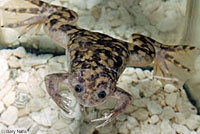
Adult in aquarium, San Diego County |
|
 |
 |
 |
 |
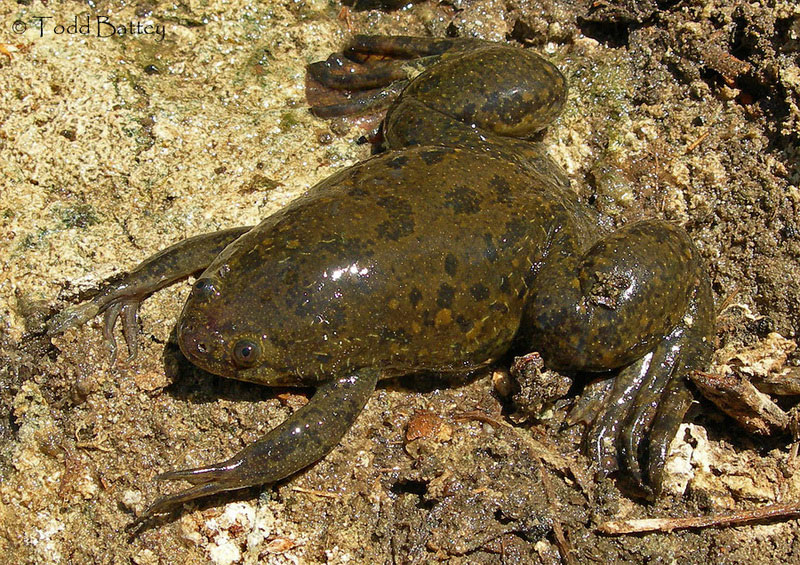
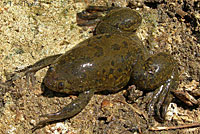
| Adult, Los Angeles County © Todd Battey |
Juvenile, Orange County
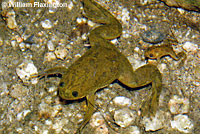
© 2004 William Flaxington |
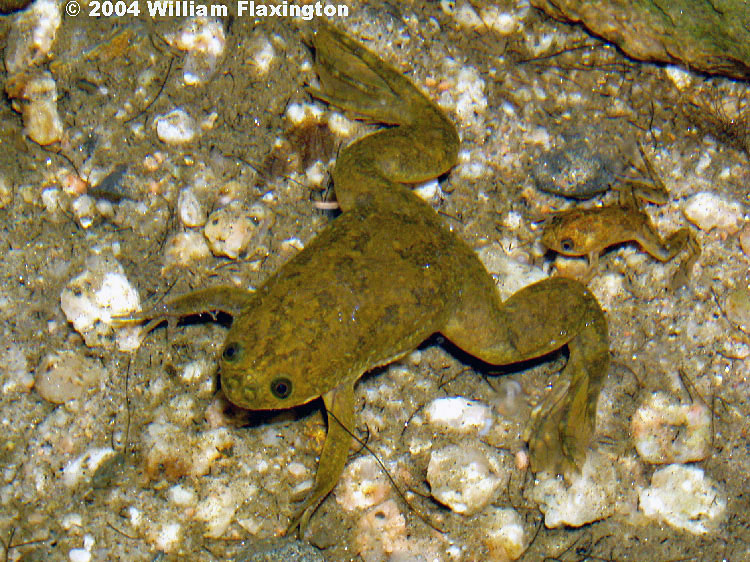
Adult and Juvenile, Orange County
© 2004 William Flaxington |
 |
 |
 |
 |
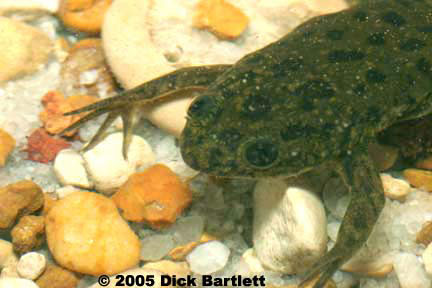
| Adult, Florida, © Dick Bartlett |
Adult, Orange County © Jeff Ahrens |
Adults in Amplexus © William Leonard
Amplexus is inguinal, or around the female pelvis, unlike the majority of California's frogs. |
 |
 |
 |
|
Adult, Orange County
© John Buckman |
Black-Crowned Night Heron eating an African Clawed Frog in San Diego County.
© Martha Wild |
|
 |
|
|
|
Most frogs use a large sticky tongue to grasp food and pull it into the mouth, but the African Clawed Frog has no tongue, being a member of the family Pipidae, the Tongueless Frogs. It is a scavenger, eating live food or dead organic waste that it locates with very sensitive fingers on its hands, an acute sense of smell, and a system of sense organs on the skin which can detect movement and vibrations in the water. It pounces on anything that moves, sucking it in through the mouth, and using its hands and feet to push the food towards its mouth and the claws on its feet to tear apart large chunks of food when necessary.
|
|
|
| |
|
|
|
| Tadpoles |
 |
 |
 |
 |
| Tadpole out of water, San Diego County |
Tadpole underwater, San Diego County |
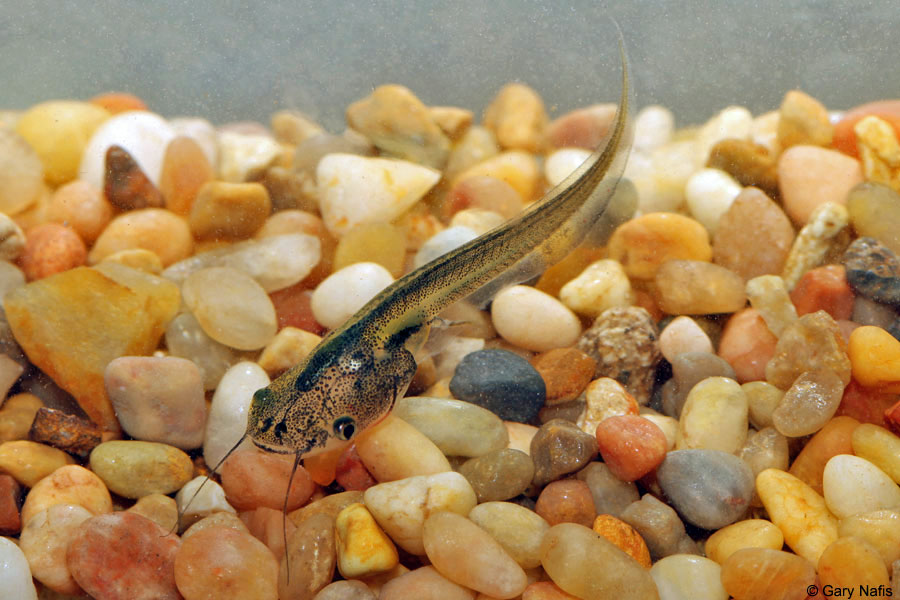
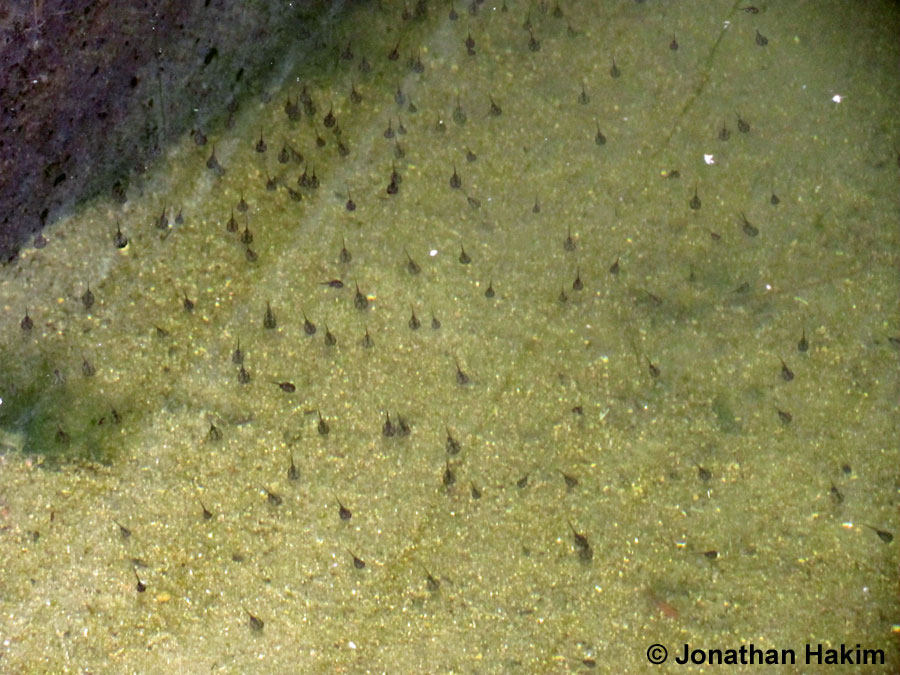
The African Clawed Frog tadpole is a filter feeder. It swims with the head down, vibrating its tail rapidly to stir up tiny bits of food particles which are sucked into the mouth and filtered out of the water which is expelled. |
 |
 |
 |
 |
| Tadpole in aquarium, San Diego County |
Tadpole with mouth open |
 |
 |
 |
 |
Tadpoles in shallow water, Orange County. © Jonathan Hakim
|
Tadpoles, San Diego County © Jay Keller |
| |
|
| Habitat |
 |
 |
|
 |
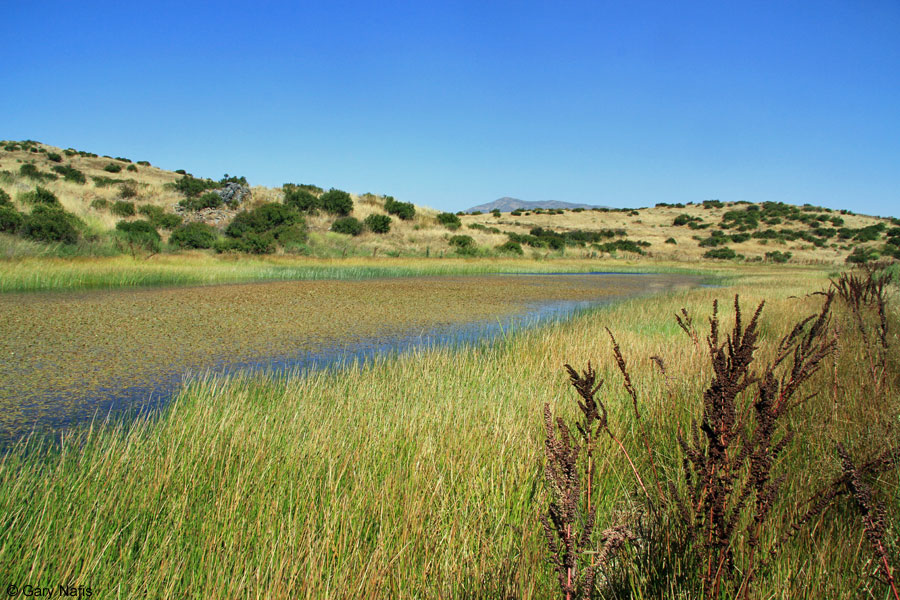
| Habitat, seasonal pond, San Diego County |
Habitat, Los Angeles County |
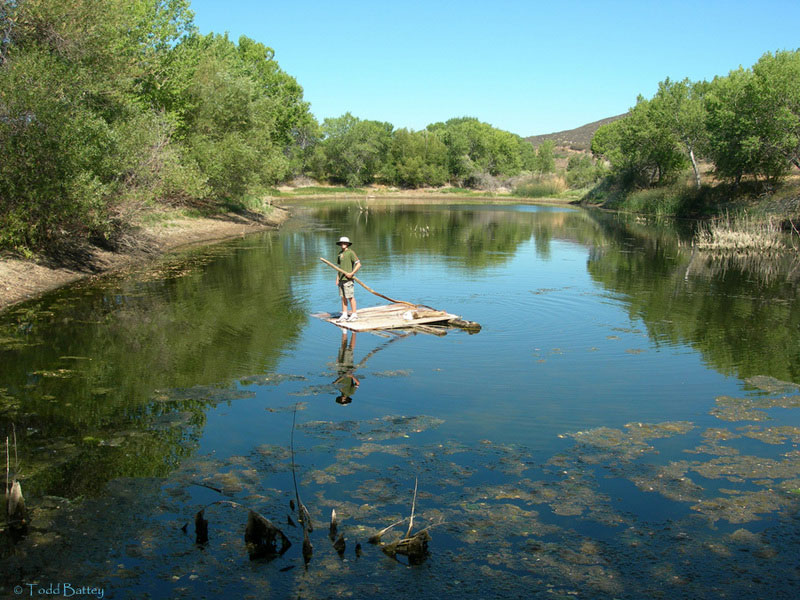
Habitat, Los Angeles County
© Todd Battey
|
 |
 |
 |
 |
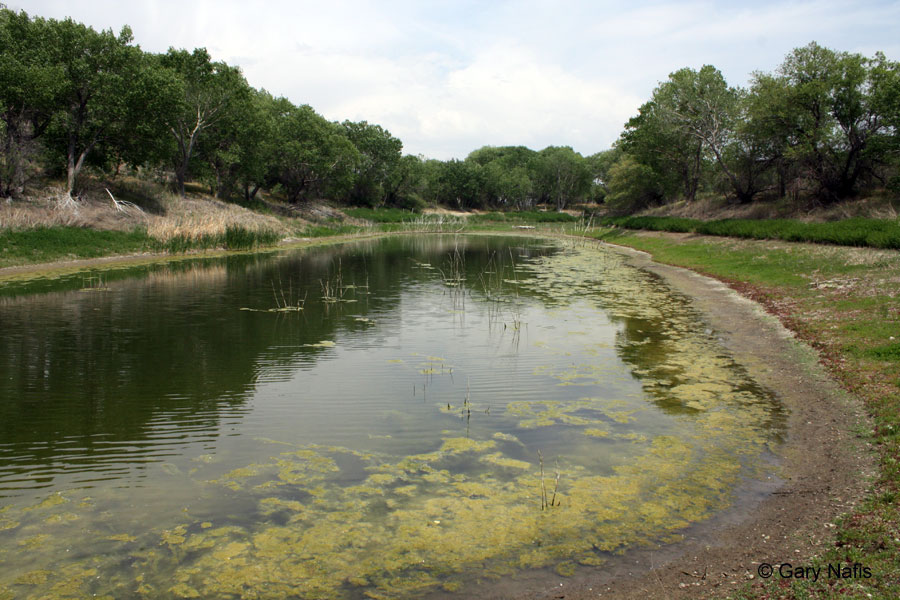
Habitat, San Diego County
|
Habitat, San Diego County |
Habitat, San Diego County |
Habitat, Orange County |
| |
|
|
|
| Short Video |
 |
|
|
|
A tadpole swimming underwater, showing the rapid movement of its tail and the suction of its large funnel-like mouth.
|
|
|
|
|
|
|
|
| Description |
| |
| Size |
Adults are 2 - 5 5/8 inches long from snout to vent (5.1 - 14.3 cm).
|
| Appearance |
A smooth-skinned frog with a flattened body and a small head with a blunt snout and small upturned eyes with no lids. Olive to brown above, with dark markings. Whitish below, sometimes spotted. No tongue. Forefeet are not webbed. Hind feet are fully webbed with sharp black claws on the inner toes. Tadpole is translucent with tentacles at the mouth corners and a slender tail ending in a filament.
|
| Life History and Behavior |
Totally aquatic, but will move over land on rainy nights and at night when their water source dries up, sometimes in mass migrations. Able to tolerate brackish habitats. Cannot tolerate loss of water or sustained travel over dry land. When pond water evaporates, frogs make and stay in shallow pits in the mud where the water temperature remains cooler than the surface temperature. In Africa, frogs burrow deep into the mud that remains when a seasonal pond dries up, where they can survive for at least 8 months without food.
When not feeding, frogs rest on the bottom or on rocks. Has been observed tolerating a wide range of conditions, including 40 percent seawater, freezing water, hot desert conditions, long periods without food, and estivating without water.
Releases slippery mucous secretions from the skin to repulse predators.
Adults live up to 16 years. |
| Voice (Listen) |
| A 2-part trill, about 1/2 second, repeated up to 100 times per minute. Males have no vocal sacs and call from underwater during the day and at night. Calls are only faintly heard in the air. |
| Diet and Feeding |
Feeds on anything it can catch; aquatic invertebrates, fish, amphibians, including its own larvae and recent metamorphs.
A very formidable predator. Finds prey by scent, and uses its toothed jaws to hold the prey while shredding it with its rear claws and pushing it into the mouth with its forearms. This allows a frog to eat prey that is too large to swallow whole, and to scavenge.
Tadpoles swim with the head down, vibrating the tail filament to stir up food, including algae, diatoms, protozoans, and bacteria. |
| Reproduction and Young |
Reproduction is aquatic.
Fertilization is external, with the male grasping the back of the female and releasing sperm as the female lays her eggs.
In California, breeds any time from January to November with a peak in April and May. In Africa, frogs are known to migrate to newly-filled rain pools to breed, but this has not been observed in US Populations.
Females mature quickly - about 6 months after metamorphosis. A female lays several hundred to thousands of eggs, depositing them singly or in small groups on vegetation and rocks. Females can produce multiple clutches each season. Eggs hatch in 2 to 3 days.
Tadpoles congregate in pools, often schooling and feeding in the middle of deeper water to avoid predation by fish. Transformation time in the wild is not known, but tadpoles transform in 10 - 12 weeks in captivity.
|
| Habitat |
In California, inhabits a variety of aquatic habitats, many of which have been disturbed or made by humans, including slow streams and drains, marshes, ponds, drainage ditches, flood channels, cattle tanks, sewage plant ponds, and golf course ponds. The highest densities of this species are found in permanent well-vegetated waters with soft substrates that do not freeze. Inhabits waters in arid and semi-arid regions in its native South Africa.
|
| Geographical Range |
Originally native to South Africa. Brought to the US in the 1940s and widely used as a standard amphibian for laboratory study and human pregnancy testing in the 1940's and 1950's. (When injected with the a pregnant woman's urine, the frog releases eggs.) A popular aquarium pet, it is now banned in several states including California. Released or escaped laboratory animals and pets were introduced into California mostly before the species was banned in California in the 1960s.
First found established in the wild in California in 1968. It has become established in California primarily in San Diego, Orange, and Los Angeles counties, but has also been found elsewhere, including San Bernardino, Santa Barbara, Riverside, Imperial, Kern, Ventura, and Yolo Counties, and in a small pond in San Francisco's Golden Gate Park. Xenopus has been reported from nine states including California, and besides those in California, established populations have also been found in Tucson Arizona, and extreme northern Baja California Del Norte.
|

 |
| Conservation Issues (Conservation Status) |
Established and spreading. Most suitable freshwater aquatic habitats in California are at risk of colonization, especially with continued human-aided introductions. A threat to native amphibians and fishes, including several endangered species. Importation and possession of this frog is prohibited in California. Still a popular pet frog in some states, but banned in several others. Eradication efforts by using poisons, draining ponds, and collecting and removing frogs, are not usually successful at removing all frogs or preventing frogs from nearby areas to re-colonize the water source.
It is against the law to capture, move, possess, collect, or distribute this invasive species in California. See California Department of Fish and Game Restricted Species Regulations information: http://www.dfg.ca.gov/licensing/specialpermits/
See: California Department of Fish and Game Restricted Species Regulations
|
|
| Taxonomy |
| Family |
Pipidae |
Tongueless Frogs |
Bonaparte, 1831 |
| Genus |
Xenopus |
Clawed Frogs |
Wagler, 1827 |
| Species |
laevis |
African Clawed Frog
|
(Daudin, 1802) |
|
Original Description |
Not available
|
|
Meaning of the Scientific Name |
Xenopus - refers to the unusual claws on the feet
Greek - xenos = strange
Greek - pous = foot
laevis - Latin = smooth, without hair, or softened
|
|
Alternate Names |
None
|
|
Related or Similar California Frogs |
None in California.
|
|
More Information and References |
California Department of Fish and Wildlife
AmphibiaWeb
Hansen, Robert W. and Shedd, Jackson D. California Amphibians and Reptiles. (Princeton Field Guides.) Princeton University Press, 2025.
Stebbins, Robert C., and McGinnis, Samuel M. Field Guide to Amphibians and Reptiles of California: Revised Edition (California Natural History Guides) University of California Press, 2012.
Stebbins, Robert C. California Amphibians and Reptiles. The University of California Press, 1972.
Flaxington, William C. Amphibians and Reptiles of California: Field Observations, Distribution, and Natural History. Fieldnotes Press, Anaheim, California, 2021.
Samuel M. McGinnis and Robert C. Stebbins. Peterson Field Guide to Western Reptiles & Amphibians. 4th Edition. Houghton Mifflin Harcourt Publishing Company, 2018.
Stebbins, Robert C. A Field Guide to Western Reptiles and Amphibians. 3rd Edition. Houghton Mifflin Company, 2003.
Behler, John L., and F. Wayne King. The Audubon Society Field Guide to North American Reptiles and Amphibians. Alfred A. Knopf, 1992.
Powell, Robert., Joseph T. Collins, and Errol D. Hooper Jr. A Key to Amphibians and Reptiles of the Continental United States and Canada. The University Press of Kansas, 1998.
American Museum of Natural History - Amphibian Species of the World 6.2
Bartlett, R. D. & Patricia P. Bartlett. Guide and Reference to the Amphibians of Western North America (North of Mexico) and Hawaii. University Press of Florida, 2009.
Elliott, Lang, Carl Gerhardt, and Carlos Davidson. Frogs and Toads of North America, a Comprehensive Guide to their Identification, Behavior, and Calls. Houghton Mifflin Harcourt, 2009.
Lannoo, Michael (Editor). Amphibian Declines: The Conservation Status of United States Species. University of California Press, June 2005.
Storer, Tracy I. A Synopsis of the Amphibia of California. University of California Press Berkeley, California 1925.
Wright, Albert Hazen and Anna Wright. Handbook of Frogs and Toads of the United States and Canada. Cornell University Press, 1949.
Davidson, Carlos. Booklet to the CD Frog and Toad Calls of the Pacific Coast - Vanishing Voices. Cornell Laboratory of Ornithology, 1995.
Alan Burdick. Out of Eden: An Odyssey of Ecological Invasion. Farrar, Straus and Giroux, 2006.
Garvey, N. 2000. "Xenopus laevis" (On-line), Animal Diversity Web
|
|
|
The following conservation status listings for this animal are taken from the April 2024 State of California Special Animals List and the April 2024 Federally Listed Endangered and Threatened Animals of California list (unless indicated otherwise below.) Both lists are produced by multiple agencies every year, and sometimes more than once per year, so the conservation status listing information found below might not be from the most recent lists. To make sure you are seeing the most recent listings, go to this California Department of Fish and Wildlife web page where you can search for and download both lists:
https://www.wildlife.ca.gov/Data/CNDDB/Plants-and-Animals.
A detailed explanation of the meaning of the status listing symbols can be found at the beginning of the two lists. For quick reference, I have included them on my Special Status Information page.
If no status is listed here, the animal is not included on either list. This most likely indicates that there are no serious conservation concerns for the animal. To find out more about an animal's status you can also go to the NatureServe and IUCN websites to check their rankings.
Check the current California Department of Fish and Wildlife sport fishing regulations to find out if this animal can be legally pursued and handled or collected with possession of a current fishing license. You can also look at the summary of the sport fishing regulations as they apply only to reptiles and amphibians that has been made for this website.
It is against the law to capture, move, possess, collect, or distribute this invasive species in California.
See: California Department of Fish and Game Restricted Species Regulations
|
| Organization |
Status Listing |
Notes |
| NatureServe Global Ranking |
|
|
| NatureServe State Ranking |
|
|
| U.S. Endangered Species Act (ESA) |
None |
|
| California Endangered Species Act (CESA) |
None |
|
| California Department of Fish and Wildlife |
None |
|
| Bureau of Land Management |
None |
|
| USDA Forest Service |
None |
|
| IUCN |
|
|
|
|
|